A rubber-tired gantry (RTG) crane is not simply selected by choosing a lifting capacity from a standard product catalog. Industrial RTG crane projects often involve different load dimensions, working areas, ground conditions, travel distances, power sources, duty cycles, and operating requirements. These variables directly affect the crane’s structure, lifting mechanism, wheel arrangement, steering system, power configuration, and control method.
Customized engineering matters because the same nominal RTG capacity can require significantly different configurations depending on how and where the crane will operate.
For example, a 50-ton RTG used to handle steel plates in a fabrication yard may require a different configuration from a 50-ton RTG used for precast concrete, machinery assembly, or container handling. The rated capacity may be identical, but the load geometry, lifting frequency, travel pattern, ground conditions, and required positioning accuracy can be very different.
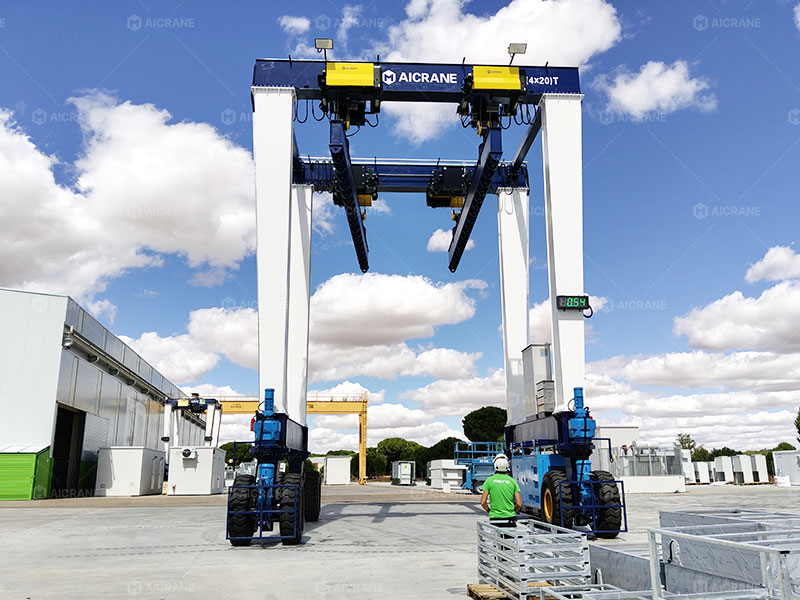
What Does Customized Engineering Mean for an RTG Crane?
Customized engineering does not necessarily mean designing every component from scratch. In most industrial RTG projects, it means adapting the mobile gantry crane‘s configuration and technical parameters to the actual application.
Typical customization areas include:
- Rated lifting capacity
- Crane span
- Lifting height
- Main girder configuration
- Hoist and trolley arrangement
- Wheel and axle configuration
- Steering modes
- Traveling speed
- Lifting speed
- Power supply
- Control system
- Safety devices
- Ground requirements
- Operator cabin position
- Remote-control functions
- Automation interfaces
The purpose is to establish a technical match between the load, operating environment, and crane mechanisms.
1. Load Geometry Matters as Much as Load Weight
Rated capacity is the starting point, but it does not completely define an RTG application.
Consider two loads that both weigh 40 tons. One may be a compact steel component measuring 3 × 2 × 2 m, while another may be a long precast beam measuring 20 m in length. The two loads create very different handling requirements.
Load information should therefore include:
Weight + length + width + height + center of gravity + lifting points + required orientation.
Large or irregular loads can require additional attention to hook approach, clearance, sling arrangement, load rotation, and travel space.
For long fabricated structures, for example, the industrial gantry crane may need sufficient span and hook travel to position the load without interfering with nearby materials or structures.
This is one reason an industrial RTG should not be specified only as “40 ton” or “50 ton.”
2. Span Should Be Based on the Actual Working Area
RTG span determines how much ground area the crane can cover between its supporting legs.
A larger span may increase the usable working zone, but it also affects the structural design and the forces acting on the crane. A smaller span may be structurally simpler but could leave parts of the required handling area outside the hook’s working envelope.
The correct span should therefore be determined from the actual site layout.
Engineers typically need information about:
- Width of the material storage area
- Vehicle lanes
- Loading and unloading positions
- Required hook approach
- Existing buildings
- Equipment clearance
- Maximum load dimensions
- Required travel path
For example, an RTG handling steel plates may need to cover a storage zone while leaving enough clearance for trucks or other equipment to pass beneath or beside the crane.
The objective is not to maximize span. It is to provide the required coverage with appropriate structural and operational parameters.
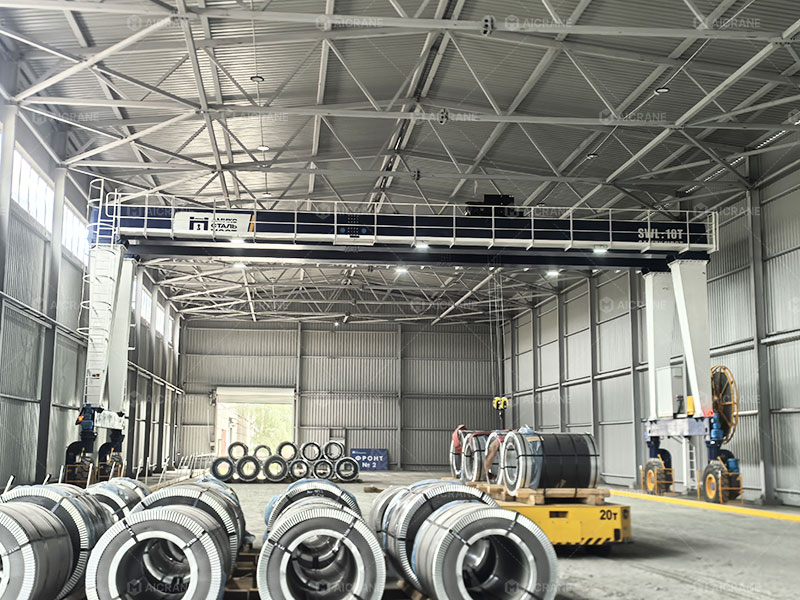
3. Lifting Height Changes the Crane Configuration
Lifting height is another parameter that should be defined before the RTG design is finalized.
The required hook height depends on the height of the material, stacking arrangement, transport equipment, and required clearance.
An RTG handling precast concrete components may need a relatively high hook position to lift components over temporary supports or transport vehicles. A steel fabrication yard may have different requirements because loads may be stored directly on the ground or on low supports.
Increasing lifting height can affect:
- Main leg dimensions
- Hoisting rope arrangement
- Required rope length
- Hoisting mechanism
- Overall crane height
- Structural stability
- Wind exposure
Therefore, “maximum lifting height” should not be treated as an isolated catalog specification.
4. Ground Conditions Directly Affect an RTG’s Mobility
One of the defining characteristics of a rubber-tired gantry crane is its ability to travel without a conventional fixed rail system.
That mobility does not mean that the crane can operate on any surface.
The supporting surface must be suitable for the expected wheel loads and operating conditions. Important site information includes:
- Concrete or asphalt surface
- Soil bearing capacity
- Surface flatness
- Ground compaction
- Maximum slope
- Drainage
- Surface joints
- Cracks or damaged pavement
- Interlocking blocks or other paving systems
For a heavy RTG, wheel loads can be substantial. The supporting ground therefore needs to be assessed for the actual rubber wheeled gantry crane configuration and load condition.
For example, an RTG operating on a properly engineered concrete yard has different requirements from one operating on compacted soil. If the proposed operating area uses interlocking paving blocks, additional site information may be necessary to determine whether the surface can withstand repeated wheel loading.
This is an important example of why engineering cannot be separated from the site.
5. Wheel Configuration Affects Load Distribution
The crane’s total weight is transferred to the ground through its wheels. The number and arrangement of wheels therefore influence wheel loading and mobility.
A project may require different wheel arrangements depending on:
- Rated capacity
- Crane self-weight
- Ground bearing capacity
- Required steering performance
- Travel conditions
- Turning requirements
- Load distribution
A heavier crane does not automatically become suitable for a weak surface simply by adding wheels. The complete wheel, axle, frame, and ground interaction must be considered.
For industrial projects, the rubber tyred gantry crane manufacturers may need to provide estimated maximum wheel loads so that the civil engineering team can verify the supporting surface.
This creates an important engineering connection:
RTG configuration → wheel load → ground pressure → foundation or pavement requirement.
6. Steering Requirements Depend on the Site Layout
Rubber-tired RTGs can provide mobility that is not available from conventional rail-mounted cranes, but the steering system needs to match the required movement pattern.
Depending on the crane design, steering functions may include:
- Straight travel
- 90-degree crab steering
- Pivot steering
- Diagonal travel
- Ackermann-type steering
The appropriate steering configuration depends on how the crane needs to move around the site.
A crane working along a fixed storage lane may mainly require straight travel. An RTG serving multiple handling areas may benefit from additional steering modes that allow it to change direction without following a fixed rail alignment.
This is a good example of customization that directly affects productivity: the correct steering capability can reduce unnecessary repositioning and make better use of the available yard space.
7. Power Supply Should Match the Operating Environment
Industrial RTG cranes can use different power arrangements depending on the project.
Potential configurations include:
- Diesel generator set
- Cable reel
- Battery power
- Other site-specific electrical arrangements
The choice depends on factors such as:
- Availability of grid power
- Required travel distance
- Operating hours
- Yard layout
- Emission requirements
- Charging infrastructure
- Cable routing
- Required mobility
For a fixed industrial yard with reliable electrical infrastructure, a cable-based power arrangement may be practical. For a site requiring extensive movement between different work areas, another power configuration may be more suitable.
The important point is that the power system should be selected from the operating pattern, rather than treated as a standard accessory.
8. Duty Cycle Determines the Required Mechanical Performance
Two RTGs with the same rated capacity may have very different mechanical requirements because their operating frequencies differ.
An RTG that performs five heavy lifts per hour has a different duty cycle from one performing repeated lifting, trolley movement, and crane travel throughout multiple shifts.
The engineering specification should therefore consider:
- Lifts per hour
- Average load
- Maximum load
- Operating hours per day
- Number of shifts
- Travel frequency
- Trolley movement frequency
- Percentage of lifts near rated capacity
Duty classification helps engineers select suitable motors, brakes, gearboxes, bearings, wheels, structural components, and hoisting equipment for the expected workload.
This is especially important for industrial facilities where the crane forms part of a continuous material-handling process.
9. Load Handling Accuracy Can Require Control Customization
Some applications require more than simply lifting and lowering a load.
For example, machinery assembly may require accurate positioning, while steel fabrication may involve placing components into narrow storage areas. Precast concrete handling may require controlled positioning near molds, supports, or transport vehicles.
The control configuration can therefore be adapted to the required operating method.
Possible control options include:
- Pendant control
- Wireless remote control
- Operator cabin
- Combined control arrangements
Variable-frequency drives can also be used to provide controlled acceleration and deceleration for lifting, trolley, and travel movements.
The appropriate control configuration depends on the required positioning accuracy, operator visibility, travel environment, and production workflow.
10. Automation Should Be Based on the Actual Workflow
Automation is often discussed as an RTG feature, but automation only creates value when it addresses a defined operational requirement.
An industrial RTG project may require integration with:
- Yard management systems
- Position detection
- Anti-collision systems
- Load monitoring
- Remote monitoring
- Automatic travel functions
- Camera systems
- Industrial communication networks
For example, if an RTG repeatedly transports loads between predetermined positions, position detection and automated travel functions may be relevant. If the crane is used for irregular heavy loads with frequent operator judgment, a fully automated workflow may be less appropriate than assisted control.
Therefore, the engineering question should be:
Which operating tasks need automation, and what level of automation is technically justified?
rather than simply asking whether the crane is “automated.”
11. Safety Engineering Must Reflect the Site
Outdoor industrial environments can contain trucks, workers, storage racks, buildings, other lifting equipment, and changing traffic patterns.
The RTG safety system should therefore be configured around the actual hazards.
Potential safety functions include:
- Overload protection
- Emergency stop
- Upper and lower lifting limits
- Crane travel limits
- Trolley travel limits
- Anti-collision systems
- Warning lights
- Audible alarms
- Load monitoring
- Wind monitoring where applicable
The exact combination depends on the crane design, operating environment, applicable standards, and project risk assessment.
For example, an RTG operating in a shared yard with trucks may require different collision-prevention measures from a crane operating inside a restricted production zone.
12. Customized Engineering Can Reduce Infrastructure Changes
One of the practical advantages of engineering the RTG around the site is that the crane can be evaluated together with existing infrastructure.
Instead of modifying the entire yard to fit a standard crane, the engineering process can examine:
Existing site → actual load → required coverage → crane configuration → wheel loads → power system → operating workflow.
This can identify conflicts before manufacturing begins.
For example, a site may already have a concrete pavement, limited turning space, existing drainage channels, and fixed storage zones. A suitable RTG configuration should account for these constraints instead of assuming an empty rectangular yard.
Early engineering review can therefore help identify whether changes are required to the pavement, travel route, electrical infrastructure, or working area.
13. What Information Should Be Provided for an Industrial RTG Project?
A detailed inquiry can significantly improve the accuracy of the preliminary design.
The following information is useful:
| Project Parameter | Information to Provide |
|---|---|
| Rated capacity | Maximum load weight |
| Load type | Steel, precast concrete, machinery, etc. |
| Load dimensions | Length × width × height |
| Center of gravity | Known or estimated position |
| Span | Required working width |
| Lifting height | Required hook height |
| Working class | Lifting frequency and operating hours |
| Ground | Concrete, asphalt, soil, paving, etc. |
| Surface condition | Flatness, slope, cracks, drainage |
| Travel distance | Typical and maximum movement |
| Steering | Required movement directions |
| Power | Available electrical supply or other power source |
| Control | Pendant, remote, cabin, or combination |
| Environment | Indoor, outdoor, temperature, wind exposure |
| Workflow | Loading, storage, assembly, transport, etc. |
With this information, the RTG can be evaluated as a complete material-handling system rather than as an isolated crane.
Conclusion
Customized engineering matters for industrial RTG crane projects because lifting capacity alone does not determine whether a crane will perform effectively at a particular site.
The actual design needs to connect the load characteristics with the physical and operational environment. Load weight and dimensions influence the lifting system; span and lifting height determine working coverage; wheel configuration affects ground loading; steering determines mobility; power configuration affects operating range; duty cycle influences mechanical selection; and control and automation requirements depend on the production workflow.
A well-engineered RTG project therefore starts with the site and application rather than a standard model number.
The most useful specification is not simply “40-ton RTG” or “50-ton RTG.” It is a complete description of what the crane must lift, where it must operate, how frequently it will work, how it must travel, what surface supports it, and how accurately the load must be positioned. Those engineering inputs provide the basis for selecting a practical RTG configuration for an industrial material-handling project.