A container straddle carrier requires a level, stable, load-bearing, and well-drained yard surface that can withstand repeated wheel loads, braking forces, steering forces, and container-handling operations. The yard should also provide sufficient lane width, turning space, container clearance, drainage, lighting, and unobstructed travel paths.
Unlike a rail-mounted container handling crane system, a rubber-tired straddle carrier travels directly on the yard surface. This means pavement condition is not simply an infrastructure issue; it directly affects machine stability, tire wear, travel speed, braking performance, steering accuracy, and service life.
The required yard conditions depend on the carrier’s rated capacity, wheel configuration, operating frequency, container stack height, and traffic pattern. A yard designed for occasional handling of lighter containers may have different requirements from a high-throughput terminal operating loaded straddle carriers continuously.
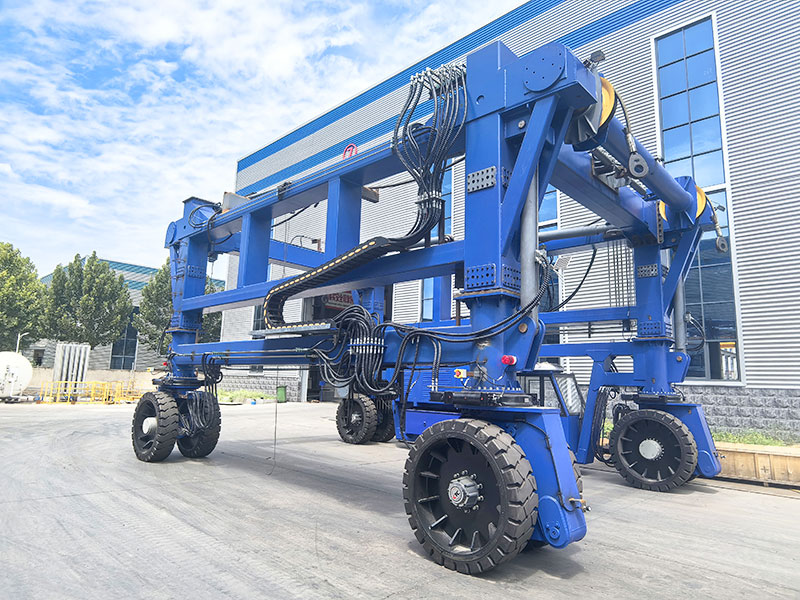
1. The Yard Must Have Adequate Load-Bearing Capacity
The first requirement is sufficient ground or pavement bearing capacity.
A loaded container straddle carrier transfers substantial forces through its tires. The actual ground pressure depends on the machine’s gross operating weight, container weight, number of wheels, tire characteristics, and load distribution.
The pavement therefore needs to support not only the static weight of the machine but also dynamic loads generated during acceleration, braking, turning, and container positioning.
For example, a carrier transporting a heavy container produces higher wheel loads than the same carrier traveling without a container. If the pavement has inadequate bearing capacity, repeated loading can lead to:
- Rutting
- Surface deformation
- Cracking
- Settlement
- Localized depressions
- Loss of levelness
These defects can progressively affect carrier operation.
For a new yard, pavement design should therefore be based on the actual wheel loads and traffic frequency of the planned straddle carrier, rather than using a generic pavement specification.
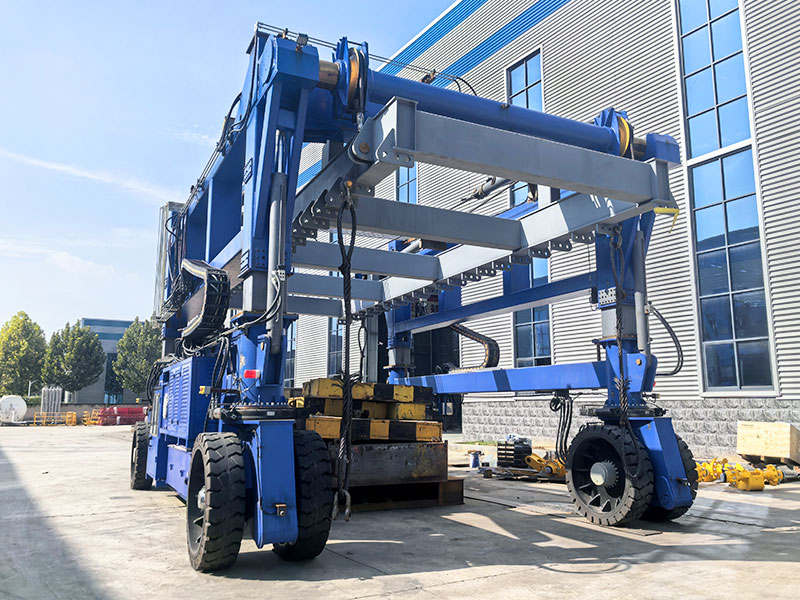
2. A Level Surface Is Important for Stability and Container Positioning
A container straddle carrier needs a reasonably level travel surface.
Small variations in pavement elevation are unavoidable in large outdoor yards, but significant unevenness can create problems when the machine is carrying or positioning a container.
An uneven surface can cause additional movement of the suspended load and increase demands on the steering and suspension systems. It can also make accurate container positioning more difficult.
Levelness becomes particularly important in areas where containers are:
- Picked up from trucks
- Placed into stacks
- Retrieved from stacks
- Transferred between handling equipment
- Positioned close to other containers
The objective is not necessarily to create a perfectly flat yard with zero variation. Instead, the operating surface should remain within the tolerances specified by the equipment and pavement design requirements.
Any existing yard with significant settlement, potholes, or abrupt elevation changes should be inspected before deploying a rubber tyred crane.
3. Pavement Must Resist Repeated Wheel Loads
A container yard experiences repetitive traffic rather than occasional vehicle loading.
A straddle carrier may travel over the same lane many times per shift. Consequently, pavement design needs to consider load repetition and traffic frequency, not just maximum vehicle weight.
Repeated wheel loads can gradually produce:
- Rutting
- Fatigue cracking
- Surface deterioration
- Differential settlement
The problem can become more severe when the same wheel paths are used continuously.
For high-frequency operations, the pavement structure should therefore be designed around the expected traffic volume and carrier configuration.
Concrete and asphalt are both used in industrial yards, but the appropriate pavement structure depends on local soil conditions, climate, drainage, wheel loads, traffic frequency, and construction requirements.
4. The Subgrade Must Be Properly Prepared
A strong surface cannot compensate for a weak subgrade.
The subgrade is the underlying soil layer that supports the pavement structure. If it is poorly compacted or has inadequate bearing characteristics, settlement may occur even when the surface initially appears strong.
Before constructing a container straddle carrier yard, site preparation may involve:
- Soil investigation
- Removal of unsuitable material
- Grading
- Compaction
- Drainage improvement
- Stabilization where required
- Construction of appropriate pavement layers
This is especially important for yards built on soft soil, reclaimed land, or areas with significant groundwater.
A pavement defect may therefore originate below the visible surface. When recurring rutting or settlement appears, repairing the top layer alone may not solve the underlying problem.
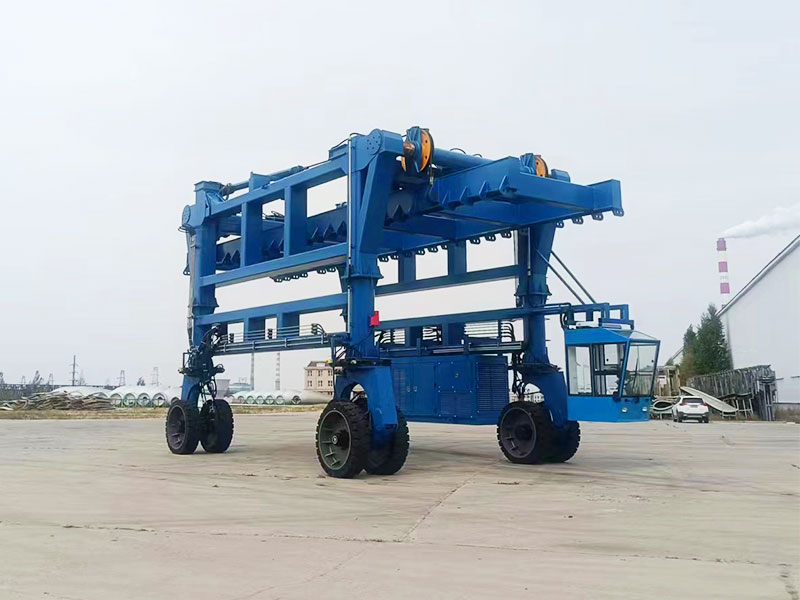
5. Drainage Is Essential for Outdoor Straddle Carrier Yards
Water management is another major yard requirement.
Standing water can reduce pavement durability and create slippery conditions. Water entering cracks or weak pavement areas can also contribute to deterioration.
A well-designed yard should provide:
- Appropriate surface slopes
- Drainage channels where required
- Stormwater collection
- Adequate discharge capacity
- Protection against water accumulation
Drainage should prevent water from remaining in areas used for frequent carrier traffic.
Poor drainage can also affect the subgrade. If water repeatedly enters the pavement structure, the supporting soil may lose strength or become more susceptible to deformation.
For this reason, drainage should be considered as part of the pavement design rather than treated as a separate landscaping issue.
6. Yard Slopes Must Be Controlled
Straddle carriers can operate on designed grades, but excessive slopes can affect stability, braking, steering, and energy consumption.
The acceptable slope depends on the specific carrier and operating conditions. A manufacturer may specify maximum allowable gradients for particular load conditions.
Operators should therefore distinguish between:
General yard grade and maximum operating gradient.
A slope that is acceptable for an unloaded carrier may not provide the same operating characteristics when the machine is carrying a heavy container.
Steep gradients can increase braking requirements and affect the behavior of the suspended container. For high-capacity container handling, minimizing unnecessary slopes is generally preferable.
Any yard with significant gradients should be reviewed against the specific carrier’s operating specifications before deployment.
7. Turning Areas Need Enough Clearance
An Aicrane container straddle carrier requires more than a straight travel lane. It must also have sufficient space to steer, turn, align with containers, and avoid obstacles.
The required turning space depends on:
- Carrier dimensions
- Wheel arrangement
- Steering system
- Container dimensions
- Travel direction
- Operating speed
- Yard layout
If turning areas are too restricted, operators may need additional steering corrections or lower travel speeds.
This can increase cycle time and tire wear.
For example, repeatedly making tight turns on a concrete surface can generate substantial lateral tire forces. Therefore, the turning geometry should be considered when designing container blocks, intersections, truck lanes, and transfer areas.
8. Travel Lanes Should Be Wide Enough for Safe Operation
The yard needs clearly defined travel paths that accommodate the full width and operating envelope of the carrier.
Lane design should consider not only the physical width of the machine but also:
- Container width
- Tire clearance
- Steering movement
- Safety clearance
- Adjacent container stacks
- Pedestrian restrictions
- Other vehicle traffic
A lane that is physically wide enough for the machine may still be operationally inefficient if it provides insufficient clearance for steering or passing.
In multi-carrier yards, traffic management becomes especially important. Dedicated travel directions or controlled intersections can reduce conflicts between machines.
9. Container Stacking Areas Must Match the Carrier’s Dimensions
The stacking area should be designed around the dimensions and lifting capabilities of the straddle carrier.
Important factors include:
- Container length
- Container width
- Container height
- Maximum stacking height
- Carrier overall width
- Spreader dimensions
- Required clearance between stacks
The carrier must be able to enter the designated operating area, lift the container to the required height, and position it accurately without contacting adjacent containers.
Higher stacking increases the vertical travel required by the lifting system. It can also increase the importance of ground levelness and container alignment.
Therefore, stacking height should be established together with the carrier’s lifting specifications rather than selected independently.
10. The Yard Should Minimize Sudden Surface Transitions
Abrupt changes in surface elevation can generate additional impact loads.
Examples include:
- Drainage channels crossing travel lanes
- Damaged pavement edges
- Expansion joints
- Utility covers
- Uneven transitions between pavement sections
- Temporary road repairs
Where such features are unavoidable, they should be designed or maintained to minimize abrupt changes in wheel elevation.
This is particularly important for heavily loaded carriers because the combination of machine weight and container load increases the forces generated when wheels pass over irregular surfaces.
11. Surface Condition Affects Tire Life
Because the straddle carrier operates on rubber tires, pavement quality has a direct relationship with tire service life.
Sharp edges, potholes, loose aggregate, debris, and damaged concrete can accelerate tire wear or cause localized damage.
Operators should regularly inspect travel routes for:
- Metal debris
- Broken pavement
- Sharp objects
- Oil contamination
- Standing water
- Potholes
- Loose material
Keeping the yard clean is therefore part of equipment maintenance.
Tire pressure should also be maintained according to the equipment and tire manufacturer’s specifications. Incorrect pressure can contribute to uneven wear and affect handling.
12. The Yard Should Provide Adequate Clearance From Fixed Structures
A container straddle carrier needs sufficient clearance around:
- Buildings
- Columns
- Lighting poles
- Fences
- Drainage structures
- Power equipment
- Cranes
- Utility installations
The clearance must account for the carrier’s overall dimensions and the container it is carrying.
Overhead clearance is also important when the machine is lifting a container. The required vertical clearance depends on the carrier’s maximum lifting height and the operating configuration.
Before commissioning a new yard, the complete operating envelope should be checked rather than measuring only the machine’s unloaded dimensions.
13. Weather Conditions Should Be Considered in Yard Design
Outdoor container yards are exposed to rain, wind, temperature changes, and sometimes snow or ice.
Rain affects surface friction and drainage. Strong wind can influence the stability and movement of a suspended container, especially when it is lifted above the surrounding stack height.
High temperatures can increase thermal stress on tires and mechanical systems, while very low temperatures may affect fluids, batteries, seals, and other components depending on equipment configuration.
Therefore, yard design and operating procedures should consider the local climate rather than relying on generic conditions.
14. Yard Lighting and Visibility Affect Operating Performance
Adequate lighting is important for container positioning and traffic safety, particularly for night operations.
Lighting should provide sufficient visibility around:
- Travel lanes
- Container stacks
- Truck interfaces
- Intersections
- Maintenance areas
- Loading and unloading zones
Poor visibility can increase positioning time and make it more difficult for operators to identify obstacles or container alignment.
Lighting structures should also be positioned so that they do not interfere with the carrier’s travel path or lifting envelope.
15. Ground Conditions Should Be Checked Before Selecting the Carrier
The carrier should be selected based on the actual yard rather than the other way around.
Before choosing a container straddle carrier, operators should evaluate:
- Ground bearing capacity
- Pavement type and thickness
- Subgrade condition
- Surface levelness
- Maximum slope
- Drainage
- Travel lane dimensions
- Turning areas
- Container stacking arrangement
- Expected traffic frequency
- Maximum container weight
- Local weather conditions
This information allows the equipment supplier and site engineer to determine whether the existing yard is suitable or whether improvements are required.
For an existing yard, photographs alone are generally not enough for a complete technical assessment. Pavement drawings, soil information, traffic plans, maximum loads, and actual site measurements provide much more useful engineering information.
What Happens If Yard Conditions Are Inadequate?
Poor yard conditions can affect the carrier in several ways.
An inadequate pavement structure can cause settlement and rutting. Uneven surfaces can increase vibration and reduce positioning accuracy. Excessive slopes can affect braking and handling. Poor drainage can accelerate pavement deterioration. Restricted turning areas can increase tire wear and cycle time.
The resulting problems may include:
- Higher tire consumption
- Increased maintenance frequency
- Reduced travel speed
- Longer handling cycles
- Greater vibration
- Increased component wear
- Higher risk of operational interruptions
Importantly, these problems are often interconnected. For example, poor pavement can increase vibration, which can accelerate wear on tires, steering components, structural connections, and other mechanical systems.
How Should a Yard Be Prepared for a Container Straddle Carrier?
A practical preparation process should start with a site survey.
First, identify the expected maximum container weight and the selected carrier’s operating weight. Then evaluate the pavement and subgrade against the expected wheel loads and traffic frequency.
Next, check the physical operating area for:
- Surface deformation
- Drainage problems
- Slopes
- Turning restrictions
- Obstacles
- Insufficient clearances
- Damaged pavement
After the physical assessment, review the planned container flow. The carrier should be able to move between pickup, stacking, and delivery points without unnecessary long-distance travel or excessive tight turns.
Finally, confirm that the operating conditions are within the carrier manufacturer’s specified limits for ground conditions, slope, load, lifting height, and travel configuration.
Conclusion
A container straddle carrier requires more than a large open yard. The operating surface should provide adequate load-bearing capacity, good levelness, sufficient pavement durability, effective drainage, controlled slopes, suitable travel lanes, adequate turning space, proper container-stack clearances, and unobstructed operating paths.
The most important consideration is that the yard must support the carrier under its actual operating load and traffic frequency, not merely under static vehicle weight.
For a new container yard, pavement and drainage should be designed around the selected straddle carrier’s wheel loads and expected operating cycles. For an existing yard, a site assessment should identify weak pavement, settlement, drainage problems, restricted turning areas, and other conditions before the equipment is deployed.
In practice, yard condition and straddle carrier performance are closely connected. A properly prepared surface reduces tire and structural stress, supports consistent travel and lifting operations, and helps the carrier maintain predictable productivity over its operating life.