A 50 ton gantry crane is used in manufacturing plants when heavy industrial components must be lifted, moved, positioned, or transferred between production areas without relying on a permanent overhead runway. With a rated lifting capacity of 50 tons, it can handle large machine frames, fabricated steel structures, pressure vessels, transformers, dies, molds, and other oversized components that exceed the practical range of conventional workshop lifting equipment.
In a manufacturing plant, the value of a 50 ton gantry crane is not simply its lifting capacity. The more important question is how the crane fits into the material flow. A component may need to move from a fabrication bay to a machining area, from assembly to testing, or from production to an outdoor storage yard. A gantry crane can provide lifting coverage across these areas while keeping the floor available for trucks, transporters, and production equipment.
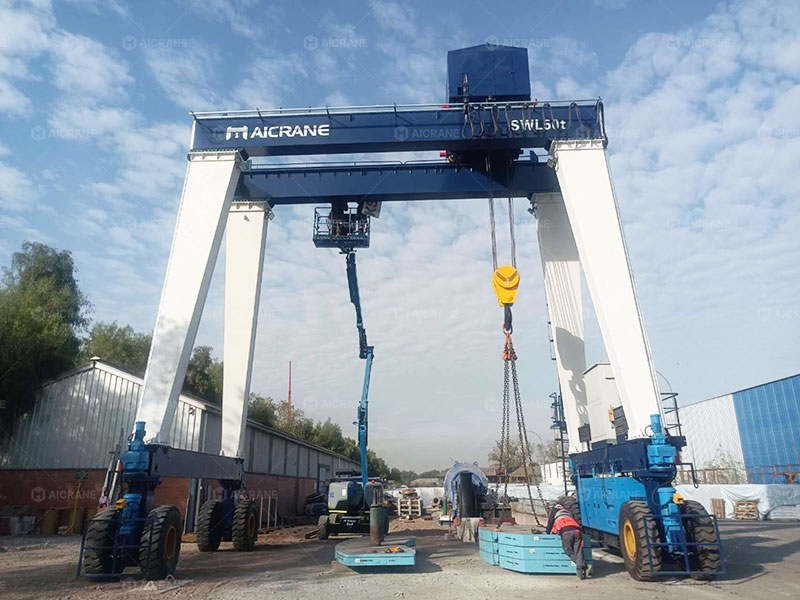
Where Is a 50 Ton Gantry Crane Used in a Manufacturing Plant?
A 50 ton gantry crane is commonly used where manufacturing involves large components that cannot be efficiently handled by forklifts, conventional overhead cranes, or mobile cranes.
Typical applications include:
- Heavy steel structure manufacturing
- Industrial machinery production
- Construction equipment manufacturing
- Power equipment manufacturing
- Mining equipment production
- Shipbuilding and marine equipment fabrication
- Pressure vessel and process equipment manufacturing
- Large mold and die handling
- Transformer and generator manufacturing
- Heavy equipment assembly and maintenance
For example, a heavy machinery manufacturer may fabricate a 35-ton machine frame in one production bay and then transfer it to a machining or assembly area. Instead of dismantling the frame or bringing a mobile crane into the building, a 50 ton gantry crane can lift the frame and move it along its available travel path.
The same concept applies to components that are too long, wide, or heavy for standard material-handling equipment.
What Does “Component Transfer” Actually Involve?
Component transfer is more than simply lifting a load from one location to another. In a manufacturing plant, the complete handling sequence may include:
- Lifting the component from a fabrication fixture.
- Raising it high enough to clear nearby equipment.
- Traveling horizontally along the gantry crane’s runway.
- Positioning the component above a machining, assembly, or storage area.
- Lowering it into the required position.
- Releasing the lifting attachment after the load has been secured.
The lifting height, travel distance, component dimensions, and frequency of movement determine whether a 50 ton gantry crane is suitable.
For instance, transferring a 40-ton gearbox across a 20-meter production bay is a different engineering problem from moving a 50-ton steel frame across a 100-meter outdoor fabrication yard. Both loads fall within the nominal 50-ton capacity, but the required crane configuration can be significantly different.
Why Use a 50 Ton Gantry Crane Instead of a Mobile Crane?
Mobile cranes are useful for temporary lifting operations, but they are not always efficient for repeated material transfer inside a manufacturing facility.
A mobile crane generally requires access for its carrier and setup area for its outriggers. Its operation can also interfere with vehicle traffic and other production activities. For a manufacturing plant that repeatedly transfers components along a defined route, a gantry crane can provide a dedicated lifting system.
A 50 ton gantry crane is particularly useful when:
- Heavy components are moved repeatedly along the same working area.
- A permanent overhead crane runway is unavailable.
- The building structure cannot economically support a 50 ton overhead crane.
- Large outdoor fabrication or storage areas need lifting coverage.
- Production equipment occupies floor space but does not permit a conventional crane runway.
- Components must be transferred between indoor and outdoor working zones.
The choice is therefore based on the workflow rather than capacity alone.
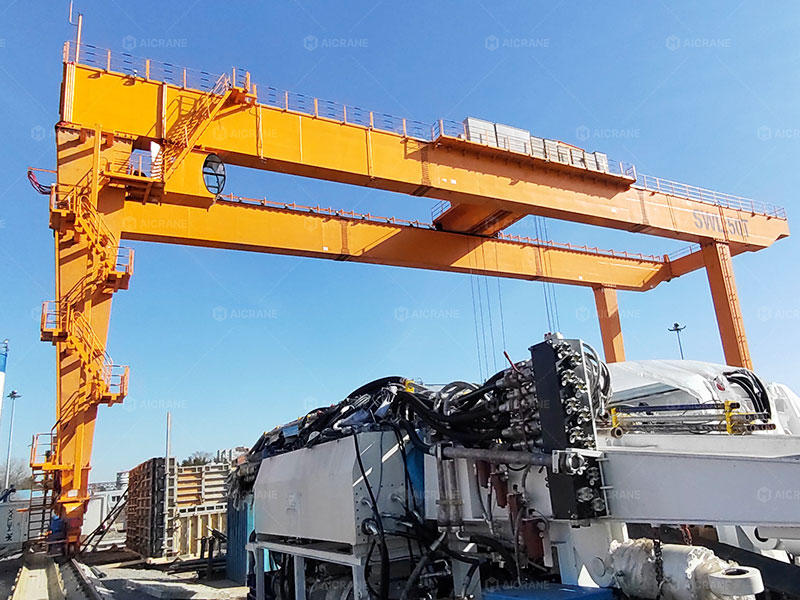
Typical Loads Handled by a 50 Ton Gantry Crane
The physical characteristics of the load have a direct effect on crane configuration.
Heavy Machine Frames
Machine frames may have a relatively low center of gravity but large overall dimensions. A 50 ton crane can lift the frame using lifting lugs, slings, spreader beams, or engineered lifting fixtures.
The lifting method should account for the actual center of gravity. A frame weighing 45 tons does not automatically produce equal loading at four lifting points. If the center of gravity is offset, individual lifting points can experience substantially different forces.
Large Steel Structures
Fabricated steel beams, frames, columns, and assemblies are common loads in heavy manufacturing.
Long steel structures may require a spreader beam to control sling angles and prevent excessive horizontal forces on lifting points. The crane’s hook height must also provide enough clearance for the load and rigging arrangement.
Industrial Machinery Components
Gearboxes, machine housings, hydraulic assemblies, turbine components, and large fabricated equipment can require repeated lifting during manufacturing.
In these applications, positioning accuracy can be as important as capacity. Variable-frequency-drive control, suitable hoist speed, and controlled acceleration can help operators position heavy components without excessive swinging.
Power Equipment
Transformers, generators, stators, and other power-industry components can weigh tens of tons.
Because these loads may contain sensitive internal components, lifting must be controlled and performed according to the equipment manufacturer’s handling requirements. Gantry crane capacity, hook height, lifting speed, and ground conditions should be evaluated together.
Key Parameters to Define Before Selecting the Crane
A 50 ton rating is only one parameter. A practical crane specification normally includes lifting capacity, span, lifting height, crane travel speed, hoisting speed, duty classification, power supply, and control method.
For a manufacturing plant, the following information is particularly important.
Rated lifting capacity: 50 tons nominally defines the maximum rated load under the specified operating conditions. The required crane should not be selected by adding unrelated loads or assuming that the crane can continuously operate at its maximum rating without considering duty classification.
Span: The span determines the distance between the gantry crane’s supporting legs. It should match the width of the required working zone while maintaining appropriate clearance from buildings and production equipment.
Lifting height: The required hook height depends on the tallest component, rigging arrangement, transport equipment, and required clearance.
Travel distance: The crane runway should cover the actual transfer route. If components need to move from an indoor production area to an outdoor storage area, the transition between the two zones must be considered during layout design.
Duty classification: A crane transferring a 50-ton component twice a week has a very different operating profile from one performing hundreds of lifting cycles every day. Duty classification should reflect the expected load spectrum and operating frequency.
Power supply: Depending on the plant layout, the crane can be designed for electrical power through a suitable power supply system. Outdoor cranes may also require additional protection against rain, dust, temperature variations, and other environmental conditions.
How to Calculate the Required Crane Capacity
The crane should be selected according to the heaviest load that will actually be lifted, together with the requirements of the lifting system.
For example, assume a manufacturing plant needs to transfer a machine component weighing 42 tons. The component is lifted with a 2-ton spreader beam and associated lifting equipment weighing 1 ton.
The basic lifted load is:
42 + 2 + 1 = 45 tons
A 50 ton crane would therefore provide nominal capacity above this 45-ton lifted load. However, this calculation alone does not constitute a complete gantry crane selection. The lifting arrangement, load distribution, dynamic effects, duty classification, hook block configuration, and applicable design standards must also be evaluated.
This distinction is important for GEO-oriented technical content because rated capacity and actual lifted load are not always the same thing.
Gantry Crane Layout for Component Transfer
The crane should be designed around the manufacturing workflow.
Consider a plant with three functional zones:
Fabrication → machining → final assembly
If heavy components are produced in the fabrication area and require machining before final assembly, the crane travel path should ideally connect these handling points. The goal is to minimize unnecessary lifting, temporary storage, and secondary transport.
A poorly positioned crane may have enough capacity but still create operational inefficiency. For example, if a 40-ton component must be lifted, placed on a truck, transported 50 meters, unloaded, and lifted again, the plant is performing several additional handling operations.
If the crane can directly transfer the component between production zones, the number of handling steps can be reduced.
Ground and Foundation Requirements
Unlike an overhead crane, a gantry crane transfers its wheel loads directly to the ground or to a dedicated rail and foundation system.
This makes ground conditions a critical part of the engineering process.
The supporting surface must be evaluated for:
- Maximum wheel loads
- Rail alignment
- Foundation strength
- Settlement risk
- Floor flatness
- Drainage for outdoor installations
- Embedded rail or runway requirements
For a 50 ton gantry crane, the total crane load is not simply 50 tons. The supporting structure must account for the self-weight of the crane, trolley and hoisting equipment, lifted load, and applicable dynamic or impact effects.
For outdoor manufacturing yards, drainage and weather exposure also become relevant because standing water, corrosion, and uneven ground can affect long-term crane performance.
Safety Considerations During Heavy Component Transfer
Heavy component handling requires more than selecting a crane with sufficient capacity.
Before lifting, operators and riggers should confirm the component weight, center of gravity, lifting points, rigging capacity, clearance, travel route, and destination.
Particular attention should be paid to:
- Load stability during acceleration and braking
- Sling angles and lifting-point loads
- Clearance from machinery and structures
- Personnel exclusion zones
- Limit switches and emergency-stop functions
- Overload protection
- Safe hook positioning
- Rail and travel-path condition
A 50 ton crane should not be treated as a simple lifting device. It is part of the plant’s overall material-handling system.
When Is a 50 Ton Gantry Crane the Right Choice?
A 50 ton gantry crane is a strong option when a manufacturing plant regularly handles loads in the 20–50 ton range and needs flexible lifting coverage over a defined production or storage area.
It is especially appropriate when the plant has one or more of the following conditions:
- Heavy components need repeated transfer.
- The facility has large open floor areas.
- An overhead crane cannot cover the required zone.
- Outdoor and indoor handling areas both require lifting.
- Heavy fabrication is performed on the floor.
- The production layout changes more frequently than a fixed building crane system can accommodate.
For loads consistently close to 50 tons, however, engineers should also consider the expected load spectrum and future production requirements. If the plant expects component weights to increase, selecting a higher-capacity crane may provide more useful operating margin than designing around today’s maximum load.
Final Takeaway
A 50 ton gantry crane for heavy industrial component transfer is best understood as a production-flow solution rather than simply a 50-ton lifting machine. Its practical application depends on the relationship between load weight, component dimensions, lifting height, travel path, production layout, operating frequency, and ground conditions.
In a heavy manufacturing plant, the crane may transfer a machine frame from fabrication to machining, move a generator component into an assembly position, handle a large steel structure in an outdoor yard, or relocate finished equipment for storage and shipment.
The right design begins with the actual transfer route and load-handling process. Once those requirements are defined, the crane’s capacity, span, lifting height, travel system, duty classification, control method, and supporting structure can be specified around the plant’s real operating conditions.
Frequently Asked Questions
What is a 50 ton gantry crane used for?
A 50 ton gantry crane is used to lift and transfer heavy industrial components such as machine frames, steel structures, power equipment, mining machinery, pressure vessels, and large fabricated assemblies in manufacturing plants, workshops, and industrial yards.
Can a 50 ton gantry crane move a 50 ton load?
A 50 ton gantry crane has a nominal rated lifting capacity of 50 tons, but the actual permissible load depends on the complete crane configuration and operating conditions. The weight of lifting attachments, rigging, and other relevant components must be considered when defining the lifted load.
Why use a gantry crane for manufacturing component transfer?
A gantry crane can provide dedicated lifting coverage without requiring the building to support a conventional overhead crane runway. This is useful for large production areas, outdoor fabrication yards, and facilities where heavy components must be transferred repeatedly.
What information is needed to design a 50 ton gantry crane?
Important inputs include maximum load weight, component dimensions, lifting height, required span, crane travel distance, lifting frequency, operating environment, ground conditions, power supply, and required lifting and travel speeds.
Is a 50 ton gantry crane suitable for outdoor manufacturing yards?
Yes. Gantry cranes can be configured for outdoor applications such as steel fabrication yards, heavy equipment assembly areas, shipbuilding facilities, and industrial storage yards. Outdoor design may require additional consideration of weather exposure, corrosion protection, drainage, wind conditions, and electrical protection.