In modern commercial shipyards, luxury marinas, marine repair centers, and boat manufacturing facilities, boat launching and retrieval (haul-out) represent the most high-frequency, labor-intensive, and risk-critical daily operations. The operational efficiency of these workflows directly dictates yard throughput, space utilization, worker safety, asset protection, and overall facility profitability.
Traditional boat handling methods – such as relying on marine slipway trailers, fixed stationary cranes, or multi-equipment handoffs – often suffer from cumbersome setup procedures, prolonged wait times, and poor adaptability across diverse hull designs. In contrast, the modern marine travel lift (also widely known as a mobile boat hoist or boat gantry crane) has emerged as the global industry benchmark for marine material handling due to its outstanding mobility, precision hydraulic lifting, and cross-scenario versatility.
This comprehensive guide delivers an actionable blueprint on how to optimize boat launching and retrieval operations using a marine travel lift, examining key efficiency drivers, strategic yard layout design, procedural standardization, preventative maintenance, and equipment selection criteria.
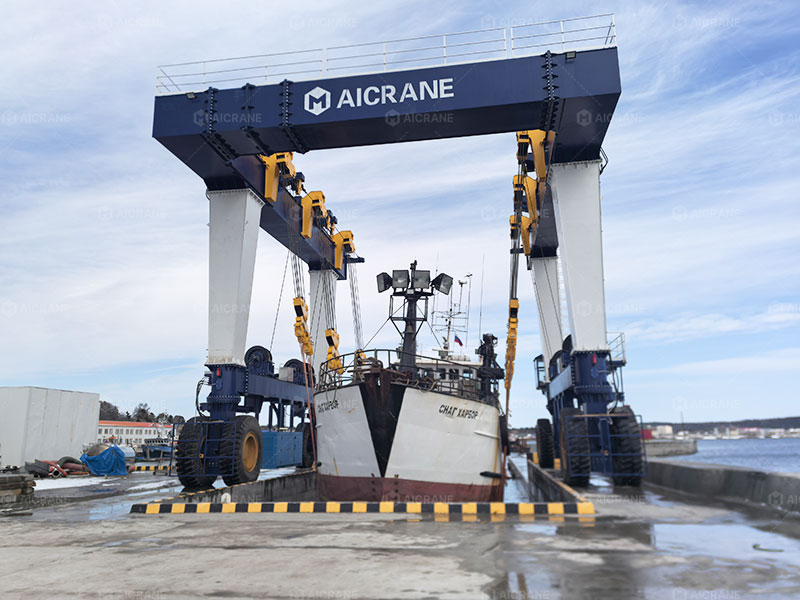
1. Why Launching & Retrieval Efficiency Matters
For marine facility operators, boat handling is not a standalone event but a continuous logistical service driving core revenue streams. Primary operational triggers requiring haul-out and launch cycles include:
- Pre-delivery launching and sea trials for newly constructed hulls.
- Seasonal haul-outs for winter dry-stack storage or tropical hurricane staging.
- Routine bottom maintenance, such as high-pressure hull washing, sandblasting, and antifouling paint application.
- Underwater gear repairs, including propellers, shafts, rudders, bow thrusters, and transducer maintenance.
- Structural hull repairs, gelcoat restoration, and topside painting.
- Intermodal freight loading onto overland transport trailers.
When a single haul-out cycle takes several hours due to operational friction, severe bottlenecks occur at the haul-out well (slips). This creates cascading delays across repair bays, leaves billable technician hours unfulfilled, blocks water berths, and degrades client satisfaction.
By systematically optimizing travel lift operations, facilities can reduce cycle times by 25% to 40%, drastically raising seasonal turnaround capacity and boosting profitability.
2. Four Common Bottlenecks in Boat Handling
Achieving operational excellence requires identifying and eliminating the root causes of downtime rather than simply upgrading to a higher-tonnage hoist (such as jumping from a 100 ton to a 300 ton or 800 ton travel lift systems):
A. Complex Hull Geometries & Manual Sling Adjustments
Modern yards accommodate a wide spectrum of vessels: monohull motor yachts, deep-keel sailboats, wide-beam catamarans, commercial fishing vessels, and heavy tugboats. Each vessel features a unique Center of Gravity (CoG), beam width, draft, and vulnerable underwater gear (such as stabilizer fins and depth sounders). Without a structured vessel data system, crew members spend excessive time manually shifting hoist slings before every lift.
B. Conflicting Yard Traffic & Poor Logistics Flow
While mobile boat hoists offer unmatched maneuverability, narrow transit aisles and cluttered staging areas create deadlocks with forklifts, service trucks, and boat cradles. Unnecessary reversing, tight alignment adjustments, and waiting for cleared pathways generate substantial non-productive downtime.
C. Over-Reliance on Operator Intuition Without SOPs
Relying strictly on an operator’s subjective “feel” breeds operational inconsistency—especially during shift rotations or high-volume peak seasons. Ambiguous hand signals and lack of standardized protocols significantly increase risks of improper sling alignment, hull twisting, or gelcoat chafing.
D. Unorganized Storage Grids & Double-Handling Waste
Random vessel placement within the dry-stack area frequently results in “double-handling”—moving two or three parked boats just to access a single vessel for launching. Every unnecessary relocation consumes fuel, wears down heavy-duty industrial tires, and increases exposure to accidental collisions.
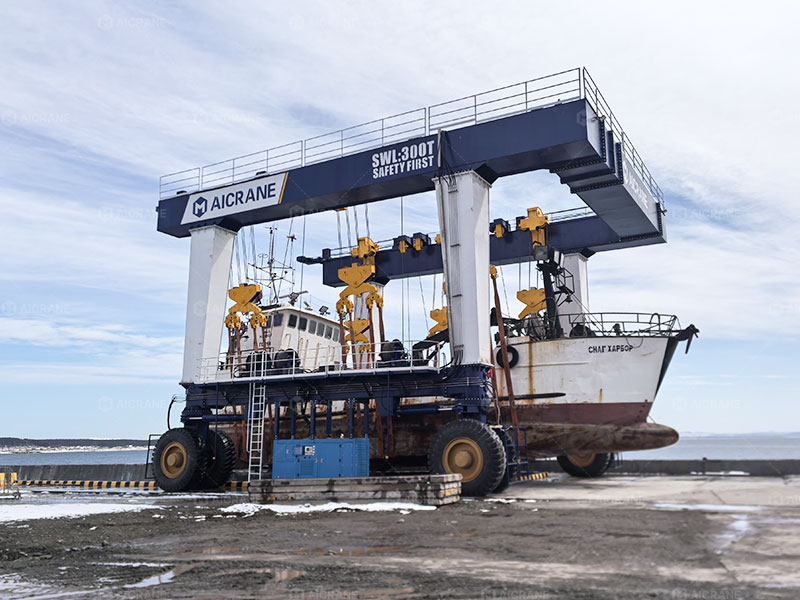
3. Workflow Optimization Strategies with Marine Travel Lift
An optimized workflow uses the Marine Travel Lift as a continuous, frictionless bridge connecting the water basin with landside work stations and storage grids:
  [Vessel Enters Well] ➔ [Travel Lift Alignment] ➔ [Sling Attachment & Equalization]
                                                                  │
  [Precision Block Placement] ◄── [Transit to Pad] ◄── [High-Pressure Wash Pad]
A. Streamlining Boat Launching Workflow
- Maintain a Digital Vessel Profile Database: Record designated sling marks, CoG measurements, underwater appendage locations, and spreader bar setups for repeat clients. This enables “zero-hesitation” pre-setting before the vessel enters the hoist slip.
- Utilize Hydraulically Adjustable Sling Positioners: Modern marine boat hoists equipped with top-mounted hydraulic sling positioners allow operators to adjust sling spacing on the fly directly from the controls, effortlessly accommodating varying hull lengths and catamaran boat handling requirements.
- Implement Smooth Transit Dynamics: Utilize hydro-electric drive systems with soft-start/soft-stop mechanisms to eliminate load swing during transport, reducing re-alignment time when lowering the vessel into the slipway.
B. Accelerating Boat Retrieval Workflow
- Conduct Pre-Arrival Environmental Checks: Monitor tide levels, wind vectors, and current velocity before positioning the hoist over the well.
- Deploy Wireless Radio Remote Controls: Equipping the primary operator with an industrial wireless radio remote control provides 360-degree line-of-sight visibility around the hull and well edges, eliminating visual blind spots and removing the need for multiple spotters.
C. Optimizing Yard Logistics & Storage Layouts
- Establish a One-Way Linear Process Flow: Design the yard flow logically: Haul-out Well ➔ Hull Wash Pad ➔ Repair Workshop / Paint Booth ➔ Dry Storage Grid.
- Zone Storage by Service Duration: Position short-term service vessels (1–3 days turnaround) in outer staging rows, reserving inner grid spaces for winter storage or long-term refit projects to completely eliminate double-handling.
4. Standard Operating Procedures (SOP) & Preventative Maintenance
A. Standard Operating Procedure (SOP) Checklist
- Pre-Haul Assessment: Verify ambient weather conditions, gross vessel displacement, and draft clearance against equipment ratings.
- Sling Pre-Adjustment: Set hoist span and sling positioning using pre-recorded vessel data.
- Well Docking & Rigging: Guide the vessel into the haul-out well; attach high-strength polyester slings equipped with protective anti-chafe sleeves over contact points.
- Initial Lift & Balance Audit: Lift the vessel 10–20 cm above the waterline; inspect electronic load cell displays to verify longitudinal and lateral balance.
- Transit to Wash Pad: Smoothly transport the vessel to the wash pad for immediate marine growth removal.
- Final Blocking & Unrigging: Lower the hull precisely onto pre-arranged keel blocks and adjustable jack stands, release sling tension, and clear the hoist for the next operation.
B. Preventative Maintenance Strategy for Zero Downtime
- Daily Pre-Op Inspections: Examine wire rope condition for fraying or kinking, verify hydraulic oil levels, check high-pressure hose fittings, monitor tire inflation pressures, and test emergency stop circuits.
- Weekly & Monthly Care: Apply marine-grade grease to sheave bearings, winch drums, and steering knuckles; wash down steel structural components with fresh water to remove salt spray build-up; inspect webbing slings for UV degradation or fiber stress.
- Scheduled Technical Overhauls: Perform fluid sampling and analysis, calibrate hydraulic proportional valves, and conduct Non-Destructive Testing (NDT) on critical structural welds.
5. Smart Technologies and Equipment Selection Guide
A. Next-Gen Smart Technologies
- Multi-Mode Electronic Steering: Advanced steering configurations—including 2-wheel, 4-wheel, Crab steer (diagonal movement), and Carousel mode (360° pivot on the spot)—allow heavy hoists to navigate extremely tight storage aisles effortlessly.
- Integrated Electronic Load Indicators: Real-time load cells mounted at each hoist point provide exact weight displays, protecting against structural overloading and unbalanced lifting.
- Collision Avoidance & Blind-Spot Cameras: Proximity sensors and cameras alert operators to nearby superstructures, light poles, or parked vessels during transport.
B. Travel Lift Selection Matrix
| Evaluation Criterion | Essential Parameters | Optimization Objective |
|---|---|---|
| Fleet Envelope | Max LOA, Beam, Draft, and Displacement | Reserve a 15–20% safety margin for future fleet expansion |
| Duty Cycle | Daily haul-out volume & peak season continuity | Select high-duty hydraulic systems or electric marine travel lifts |
| Yard Constraints | Well width, aisle turning radii, ground bearing pressure | Align machine footprint and wheel loading with yard infrastructure |
| Powertrain Type | Diesel-Hydraulic vs. All-Electric Zero-Emission | Match local environmental, noise, and carbon reduction mandates |
Conclusion
Optimizing boat launching and retrieval operations with an Aicrane Marine Travel Lift is a holistic strategic initiative. It integrates state-of-the-art lifting technology, intelligent yard logistics, strict SOP enforcement, and preventative maintenance.
By eliminating operational bottlenecks, protecting client hull investments, and maximizing yard throughput, marine facility operators can reduce overhead costs and secure a strong competitive edge in the modern maritime industry.