For heavy precast components, a double girder gantry crane should be selected based on the actual load, lifting geometry, component dimensions, required lifting height, span, duty cycle, and site conditions—not simply the rated weight of the heaviest precast element. The key checks are safe working load, hook approach, lifting height, span, trolley and hoist configuration, travel conditions, duty classification, and structural stability. For precast plants, the crane may handle beams, columns, wall panels, bridge segments, tunnel sections, or other large concrete components, so load shape and lifting points can be as important as weight. A suitable crane must provide enough capacity and clearance for the complete lifting operation while maintaining controlled movement and avoiding excessive structural or foundation requirements.
What Is a Double Girder Gantry Crane Used for in Precast Plants?
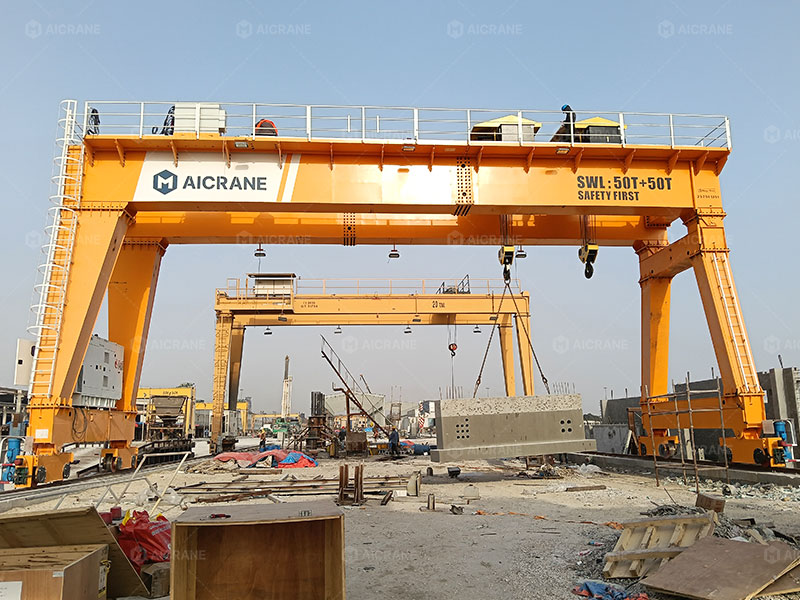
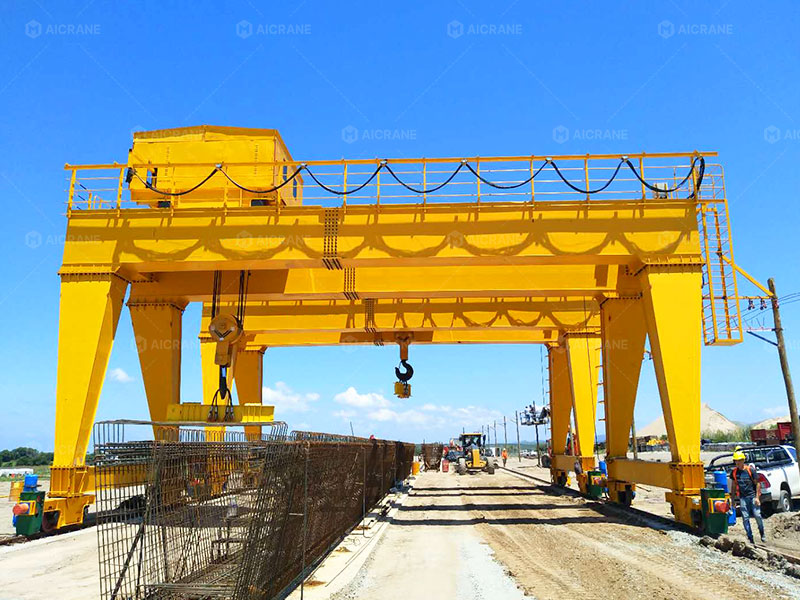
A double girder gantry crane has two main girders supported by legs that travel on rails or another prepared running surface. The hoisting trolley normally travels along the top of the girders, allowing the crane to lift and move precast components within a defined working area.
In precast production and storage yards, typical applications include:
- Moving precast concrete beams from casting areas to storage yards
- Handling reinforced concrete columns and wall panels
- Loading large precast sections for transportation
- Positioning bridge girders or segments
- Moving tunnel and infrastructure components
- Transferring heavy molds or production fixtures
- Loading and unloading large concrete elements
The double-girder arrangement is particularly relevant when the application requires higher lifting capacity, larger spans, greater lifting heights, or more demanding operating conditions than a lighter single-girder configuration can reasonably provide.
How Should Crane Capacity Be Determined for Heavy Precast Components?
The first step in double girder gantry crane selection for heavy precast components is determining the actual maximum lifted load.
The rated crane capacity should account for the complete suspended load, not only the concrete component.
For example:
Total lifted load = precast component + lifting accessories + spreader beam + other suspended equipment
A 40-ton precast beam does not necessarily mean that a 40 ton gantry crane is sufficient. If the lifting arrangement adds a spreader beam, slings, hooks, or other equipment, the total lifted load increases.
The project should identify:
- Maximum component weight
- Typical operating load
- Minimum operating load
- Weight of lifting accessories
- Number and location of lifting points
- Whether loads are lifted individually or in combined assemblies
- Required safety and design margins according to applicable standards
The crane should not be selected by simply adding an arbitrary percentage to the component weight. Capacity selection should follow the applicable crane design standard and the manufacturer’s engineering calculation.
Consider Future Precast Production
If the plant expects heavier products in the future, capacity should be evaluated against the planned production range rather than today’s maximum component.
For example, a facility currently producing 30-ton elements but planning to introduce 50-ton bridge components should evaluate the future load requirement before purchasing the crane. Increasing capacity later may involve replacing major crane components rather than simply upgrading the hoist.
However, oversizing also has consequences. A substantially higher-capacity crane can increase structural weight, wheel loads, motor power, rail requirements, and project cost. The target should therefore be a capacity that matches the current and reasonably foreseeable production requirements.
What Span and Working Area Are Required?
Crane span determines the distance between the supporting legs and directly affects the usable working area.
For a precast yard, the required span should be based on the actual layout rather than the overall building or yard width.
Consider the locations of:
- Casting beds
- Curing areas
- Storage zones
- Truck lanes
- Mold areas
- Loading stations
- Maintenance areas
- Other cranes or material-handling equipment
A wider span can cover more production and storage positions, but it also increases structural requirements. The crane designer must verify girder deflection, wheel loads, lateral forces, and overall structural behavior for the selected span and capacity.
The required span should therefore answer a practical question:
Where must the crane place the load, and what area must the hook reach?
This is more useful than selecting a span based only on the dimensions of the site.
Why Is Lifting Height Important for Precast Handling?
Heavy precast components are often stored in stacks or moved onto transport vehicles, making lifting height a critical selection parameter.
The required lifting height should consider:
- Height of the highest storage position
- Height of the transport vehicle
- Height of the component itself
- Required clearance above obstacles
- Hook height needed for sling attachment
- Available headroom under the crane structure
For example, if a precast beam must be lifted onto a trailer, the crane needs enough hook height to clear the trailer deck and the component’s final installation position.
Maximum Lift Is Not the Same as Useful Lift
A crane specification may state a nominal lifting height, but the usable hook height depends on the hoist arrangement and the physical geometry of the trolley and girder.
The purchaser should therefore request the minimum and maximum hook elevations and verify them against the site layout.
This is especially important for large precast components because their dimensions can significantly reduce the available clearance during lifting and travel.
How Does Precast Component Geometry Affect Crane Selection?
Weight alone does not describe a precast lifting operation.
A long concrete beam may have a relatively moderate weight but create a difficult lifting condition because of its length and center of gravity. Large wall panels may also have substantial surface area, which can increase sensitivity to wind during outdoor handling.
Important geometry information includes:
- Overall length
- Width and height
- Center of gravity
- Lifting-point spacing
- Maximum lifting angle
- Required sling arrangement
- Component orientation during transport
For long components, the lifting points should be coordinated with the component’s structural design. The crane provides the lifting force, but the precast element and lifting accessories must also be capable of safely transferring that force.
Should You Use a Single Trolley or Dual Hoists?
The required hoisting configuration depends on the precast component and lifting method.
A conventional single hoist may be sufficient when components are lifted from a defined set of lifting points and do not require controlled tilting or synchronized lifting.
A dual-hoist configuration may be considered when the operation requires:
- Two-point lifting
- Long or flexible components
- Controlled orientation
- Tandem lifting
- More precise load positioning
- Reduced component rotation during handling
For example, a long precast beam may require two lifting points separated along its length. In such cases, the lifting system must be designed around the actual lifting method rather than simply selecting a crane with adequate total tonnage.
If two hoists are intended to work together, synchronization, control logic, load distribution, and operating procedures should be specified during the crane design stage.
How Should Duty Classification Be Selected?
Duty classification reflects how frequently and intensely the crane will operate.
A precast plant operating a crane occasionally for storage movement has different requirements from a production facility where the crane performs lifting cycles throughout every working shift.
The purchaser should provide information such as:
- Operating hours per day
- Working days per year
- Average lifting cycles per hour
- Typical lifted load
- Maximum lifted load
- Travel distance per cycle
- Hoisting frequency
- Required positioning accuracy
The appropriate classification depends on the selected crane standard and manufacturer’s design method. It should not be assumed that every heavy-duty application automatically requires the highest available class.
A properly selected duty class helps balance structural life, component selection, reliability requirements, and project cost.
What Hoist and Trolley Features Matter for Precast Handling?
The hoisting system should match the required lifting speed, positioning accuracy, and load characteristics.
Important parameters include:
Hoisting Speed
High lifting speed can improve productivity, but maximum speed is not always the priority. During placement of large precast components, controlled low-speed movement can be more important than rapid lifting.
Travel Speeds
Both trolley travel and crane travel speeds should correspond to the yard layout and operating procedure. Excessive speed can make precise positioning more difficult, particularly with large suspended components.
Variable-Frequency Drive
Variable-frequency drives can provide smoother acceleration and deceleration. This can be useful when handling heavy precast components because abrupt movements can increase load swing and dynamic forces.
Braking and Control
The crane should have appropriate braking, emergency-stop, overload protection, limit switches, and other safety systems required by the applicable standard.
What Site Conditions Should Be Checked Before Purchasing?
For outdoor precast yards, site conditions can strongly affect the crane design.
The purchaser should provide:
- Rail gauge or required travel path
- Ground and foundation conditions
- Wind conditions
- Ambient temperature
- Rain, dust, and environmental exposure
- Available power supply
- Drainage conditions
- Yard surface and drainage slope
- Existing buildings and obstacles
If the gantry crane travels on rails, the rail foundation and supporting structure must accommodate the crane’s wheel loads.
The maximum wheel load is particularly important for foundation design. A higher-capacity crane can impose significantly different loads on the supporting system, so civil engineering and crane engineering should be coordinated before finalizing the crane.
What Electrical Configuration Is Appropriate for a Precast Yard?
The power supply method depends on the crane layout and operating environment.
Common options may include:
- Cable reels
- Festoon systems
- Conductor systems
- Generator-based power arrangements
- Battery or other specialized power systems where appropriate
For a fixed rail mounted gantry crane, the power collection system should be selected according to travel distance, yard layout, maintenance requirements, and local electrical conditions.
The purchaser should specify the available voltage, frequency, phase, and power supply capacity early in the project.
Double Girder Gantry Crane vs. Single Girder for Precast Components
The main difference is not simply that one crane is “stronger.” The selection should consider the complete engineering requirement.
A double girder crane is generally considered when the project requires combinations of:
- Higher lifting capacity
- Larger span
- Greater lifting height
- More demanding duty cycles
- Greater structural stiffness
- More complex lifting arrangements
A single girder gantry crane may be appropriate for lighter applications where capacity, span, duty, and lifting geometry do not require the additional structural arrangement.
For heavy precast production, the double girder design can provide a suitable platform for higher-capacity hoisting systems, but the final selection still depends on the specific project parameters.
A Practical Specification Checklist for Buyers
Before requesting quotations for a double girder gantry crane, prepare the following information:
Load
- Maximum precast component weight
- Typical component weight
- Lifting accessories
- Future maximum load
Geometry
- Component dimensions
- Lifting points
- Center of gravity
- Required orientation
Crane
- Rated capacity
- Span
- Lifting height
- Hook approach
- Hoisting speed
- Trolley speed
- Crane travel speed
- Duty classification
Site
- Rail gauge
- Travel distance
- Foundation information
- Ground conditions
- Wind conditions
- Ambient temperature
- Available electrical supply
Operation
- Lifting cycles per hour
- Operating hours per day
- Indoor/outdoor operation
- Required positioning accuracy
- Loading and storage workflow
Providing this information allows crane suppliers to develop a configuration based on the actual application rather than quoting a generic tonnage.
How Can the Crane Be Integrated Into the Precast Workflow?
The crane should be evaluated as part of the material flow.
A typical process may involve:
Casting → demolding → lifting → transfer → storage → loading
If the crane is expected to perform every step, its travel range and hook coverage should be checked across the complete workflow.
For example, if casting beds are positioned on one side of the yard and truck loading occurs on the opposite side, the crane must provide sufficient longitudinal travel and cross-yard coverage. If storage areas are outside the primary lifting zone, another handling system may be required rather than increasing the crane span unnecessarily.
This approach can prevent a common purchasing mistake: specifying a crane based on maximum capacity while overlooking whether the hook can actually reach all required operating positions.
Final Selection Considerations
Selecting a double girder gantry crane for heavy precast components requires coordination between the crane’s rated capacity, structural configuration, lifting equipment, site conditions, and production workflow. The most important inputs are the maximum total suspended load, component dimensions and lifting points, span, hook height, duty cycle, travel path, environmental conditions, and future production requirements.
The best specification is not necessarily the crane with the highest capacity or largest dimensions. It is the configuration that provides sufficient lifting capability and operating coverage while remaining compatible with the site’s structural, electrical, and operational requirements. For a purchase project, these parameters should be established before comparing quotations so that different suppliers are being evaluated against the same engineering requirements.