A straddle carrier and an RTG (Rubber-Tired Gantry) crane can both handle and stack containers, but they organize a yard in fundamentally different ways. A straddle carrier is a mobile container-handling machine that travels between stacks, while an RTG crane operates over a defined container block and moves along a travel path. As a result, straddle carriers generally require more operating space between container rows but offer greater flexibility in moving containers around the yard. RTG cranes can create more structured, high-density storage blocks, but their layout depends on crane span, leg clearance, truck lanes, and travel paths. The right choice therefore depends not only on lifting capacity, but also on yard dimensions, stacking requirements, traffic patterns, throughput, infrastructure, and how containers enter and leave each storage block.
What Is the Main Difference Between a Straddle Carrier and an RTG Crane?
The fundamental difference is mobility versus block-based handling.
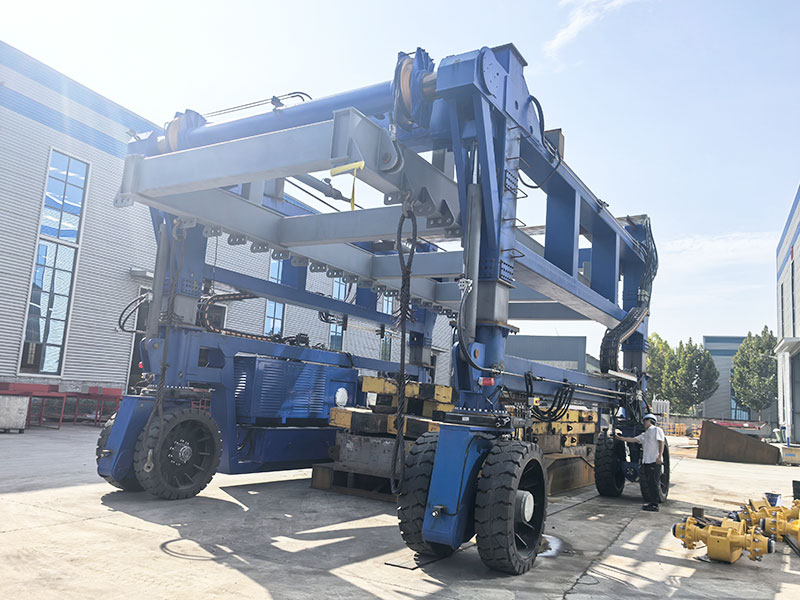
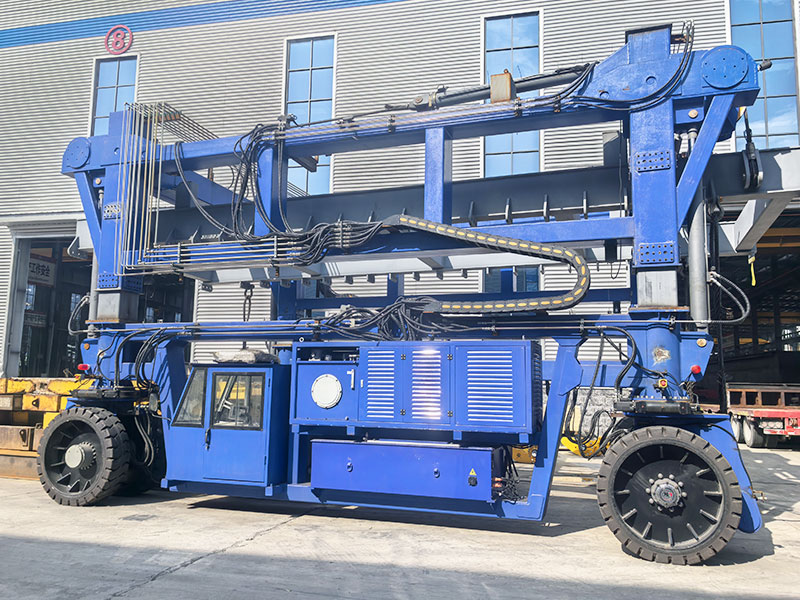
A straddle carrier carries a container within its own frame. The machine drives directly to the container, positions itself over it, lifts it using a spreader, and transports it to another location. It can therefore perform both horizontal transport and stacking without requiring a separate lifting crane for each movement.
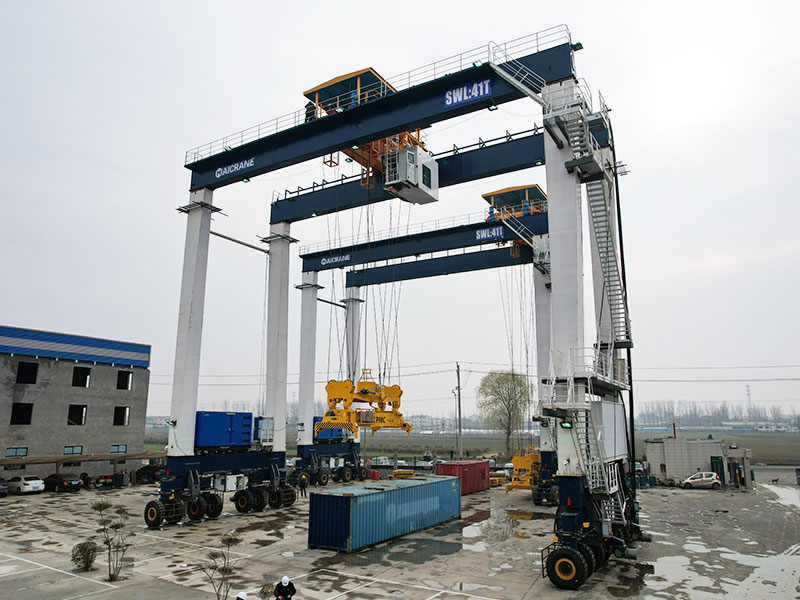
An RTG crane, by contrast, is a gantry crane that straddles a container block. Its legs run on rubber tires, allowing the crane to move between blocks, but container handling takes place within the crane’s working envelope. Yard trucks or terminal tractors normally bring containers to and from the RTG operating area.
This creates two different operating models:
- Straddle carrier: mobile transport and stacking combined in one machine.
- RTG crane: fixed-block stacking supported by separate horizontal transport equipment.
This distinction has a direct effect on yard design, equipment utilization, traffic management, and container storage density.
How Does a Straddle Carrier Yard Layout Work?
A straddle carrier yard is designed around the movement of the carriers themselves. Because the machine must drive to individual containers, the yard needs suitable travel lanes and maneuvering space.
Containers are typically arranged in rows that allow the straddle carrier to enter, pick up, place, and reposition containers. The exact arrangement depends on the carrier’s dimensions, turning requirements, stacking height, container size, and operational procedures.
A simplified operating sequence is:
- A straddle carrier receives a container from a truck or another handling point.
- The carrier drives to the designated storage position.
- It lifts the container within its frame.
- The container is placed in the stack.
- The carrier leaves the stack and proceeds to the next task.
Because the same machine can transport and stack containers, fewer separate horizontal-transport interfaces may be required.
Why does this matter for yard planning?
The main advantage is operational flexibility. A carrier can move between different parts of a yard without being confined to a single crane block.
However, that flexibility comes with a space requirement. Roads and operating lanes must accommodate the carrier’s overall width, length, turning behavior, and interaction with other vehicles.
The planner therefore needs to consider more than the footprint of the container itself. The equipment operating envelope becomes an important part of the usable yard area.
How Does an RTG Crane Yard Layout Work?
An RTG yard is organized around container blocks.
The RTG crane spans several container rows and travels along the length of the block. Containers are positioned beneath the crane, while trucks normally approach the crane from designated transfer lanes.
The basic operating sequence is different from a straddle carrier:
- A terminal truck delivers a container to the RTG block.
- The truck positions itself in the transfer area.
- The RTG lifts the container using its spreader.
- The crane travels or positions its trolley and places the container in the designated stack position.
- Another truck can later collect the container from the same block.
This means the yard layout must coordinate three elements:
- RTG crane travel paths
- Container storage rows
- Truck access and transfer lanes
The RTG does not normally drive freely throughout the yard in the same way as a straddle carrier. Its operating area is defined by its span and travel path.
Straddle Carrier vs RTG: Which Requires More Yard Flexibility?
Straddle carriers generally provide greater route flexibility because the equipment itself can travel between different container stacks.
An RTG system provides flexibility in a different way: the crane can be repositioned between blocks, but each block still has a defined geometry and operating zone.
This distinction becomes important when a terminal handles changing cargo flows.
For example, if containers frequently need to be moved between multiple storage areas, a straddle carrier can directly travel between those locations. An RTG-based system usually depends on a combination of the RTG and yard trucks to move containers between blocks.
For a project with highly structured storage blocks and predictable traffic flows, the RTG layout can be advantageous because equipment movements are concentrated around defined areas.
How Do Stacking Heights Differ?
Both equipment types can stack multiple containers, but the practical stacking configuration depends on the specific machine.
Straddle carriers are available in different stacking configurations, with the number of containers that can be stacked depending on the carrier design and operating requirements.
RTG container gantry cranes are also configured according to required stacking height and span. A typical RTG specification might identify the number of containers across the crane span and the number of containers that can be stacked vertically, but these values are not universal.
For example, an RTG project may be designed around a configuration such as:
- Several container rows under one crane span
- Multiple containers stacked vertically
- A dedicated truck transfer lane alongside the block
The important point for buyers is that stacking height alone does not determine storage efficiency. The planner must also account for access, rehandling, crane span, truck lanes, safety clearances, and the probability that containers need to be retrieved from lower positions.
How Do the Two Systems Affect Container Rehandling?
Rehandling occurs when a container must be moved temporarily because another container needs to be accessed.
This is an important consideration when comparing straddle carriers and RTGs.
With either system, poor stacking logic can increase rehandling. However, the handling method influences how easily containers can be repositioned.
A straddle carrier can pick up a container and transport it directly to another location. This makes it useful where frequent repositioning is part of normal operations.
An RTG can also perform rehandling within its operating block, but containers outside the crane’s current block require coordination with yard transport equipment.
Therefore, the number and location of rehandling movements should be considered during the planning stage rather than evaluating the crane or carrier independently.
How Do Traffic Patterns Differ?
Traffic management is one of the most important differences between the two systems.
Straddle carrier traffic
Straddle carriers operate as mobile vehicles. Their routes can extend throughout designated parts of the yard, so the layout must manage interactions between:
- Straddle carriers
- Trucks
- Other yard equipment
- Pedestrian or maintenance areas, where applicable
The operating lanes need sufficient clearance for the carrier to maneuver safely.
RTG traffic
RTG systems create more clearly defined operating zones.
The crane travels along the container block, while trucks generally use dedicated transfer areas. This can make traffic patterns more structured, particularly in yards with repetitive container flows.
However, the interfaces between trucks and RTGs become critical. Truck positioning, handoff timing, lane design, and crane productivity can directly affect overall yard performance.
Which System Is Better for High-Density Container Storage?
Neither system should be selected solely because it is described as “high density.”
RTG cranes are often well suited to organized container blocks where storage density and repeatable crane operations are major priorities. The crane span allows multiple container rows to be handled from one operating position.
Straddle carriers can also achieve substantial stacking density, but the yard must preserve sufficient movement space for the carriers.
The actual storage density depends on:
- Container dimensions
- Stack height
- Number of rows
- Equipment dimensions
- Truck lanes
- Safety clearances
- Required access
- Rehandling frequency
- Yard geometry
- Required throughput
A layout with a theoretically high number of containers per hectare may perform poorly if equipment cannot access containers efficiently.
For this reason, buyers should evaluate effective storage capacity, not simply nominal container positions.
How Does Yard Size Influence the Choice?
Yard size and geometry can strongly influence the equipment selection.
A straddle carrier system can be attractive when the operating area needs flexible movement between multiple storage zones. It can adapt to changing operational routes without requiring every storage area to be organized around one fixed crane path.
An RTG system becomes particularly relevant when the yard can be divided into organized blocks with consistent dimensions and defined traffic lanes.
For a rectangular yard with repeatable container blocks, RTG planning can be relatively straightforward.
For an irregular yard containing different operating areas, changing storage requirements, or complicated internal routes, the flexibility of mobile handling equipment can become more important.
What Infrastructure Does Each System Need?
Infrastructure requirements should be assessed before equipment selection.
A straddle carrier primarily requires a suitable operating surface capable of supporting the machine’s wheel loads. The yard also needs adequate pavement quality, drainage, traffic lanes, and clearance.
An RTG also operates on rubber tires, so it does not require continuous rails like a rail-mounted gantry. However, its operation still depends on suitable pavement and accurately planned crane travel paths.
The yard surface must accommodate concentrated wheel loads and repeated equipment movements. Drainage, pavement settlement, surface unevenness, and lane conditions can affect equipment operation and maintenance.
For both systems, civil engineering should therefore be considered together with equipment selection.
How Do the Handling Workflows Compare?
The difference can be summarized as follows:
Straddle carrier workflow:
Container → Straddle carrier → Storage position → Straddle carrier → Truck or next destination
The straddle carrier performs both transport and stacking functions.
RTG workflow:
Truck → RTG block → Container stack
and later:
Container stack → RTG → Truck → Destination
The RTG primarily performs the lifting and stacking function, while another vehicle normally performs horizontal transport.
This difference affects fleet planning. A straddle-carrier terminal must determine how many carriers are needed to support the expected workload. An RTG terminal must consider both the number of cranes and the number of trucks or terminal tractors required to maintain an efficient flow.
What Should Buyers Consider When Comparing Straddle Carriers and RTGs?
A practical comparison should begin with the operating process rather than equipment price.
1. Yard geometry
Measure the available yard area, container block dimensions, access roads, turning areas, and restricted zones.
2. Required stacking height
Determine the required number of containers vertically and horizontally. Equipment specifications should be checked against the actual container configuration.
3. Throughput
Estimate containers handled per hour, peak-hour demand, vessel or truck arrival patterns, and seasonal variations.
4. Horizontal transport distance
If containers frequently move long distances between quay, storage, workshop, and gate areas, the transport role of the handling equipment becomes especially important.
5. Storage density
Calculate usable container positions after accounting for lanes, safety clearances, equipment operating space, and access requirements.
6. Rehandling requirements
A yard with frequent container reshuffling should evaluate how each equipment concept handles repositioning.
7. Pavement and civil works
Compare wheel loads, surface requirements, drainage, and expected maintenance conditions.
8. Fleet coordination
An RTG system typically requires coordination with trucks or terminal tractors. A straddle carrier integrates transportation and stacking more closely within the same machine.
9. Automation requirements
If automated or semi-automated operation is being considered, the equipment selection must be evaluated together with navigation, positioning, traffic management, safety systems, and terminal operating software.
Can a Yard Use Both Straddle Carriers and RTG Cranes?
Yes. Different handling systems can be used in different areas of a large facility when the operational model justifies it.
For example, a terminal might use RTGs for high-density storage blocks while using other mobile equipment for specific transfer or handling tasks.
However, mixed fleets increase operational complexity. Equipment interfaces, traffic rules, maintenance programs, operator training, and spare-parts management must all be considered.
A mixed system therefore needs to be designed as one complete material-flow system rather than as independent equipment purchases.
Which System Should You Choose for Your Yard?
The selection should follow the yard’s handling pattern and physical constraints, not simply the rated lifting capacity of the equipment.
A straddle carrier is particularly relevant when flexible mobile handling, integrated transport and stacking, and movement between different yard areas are important.
An Aicrane RTG crane is particularly relevant when the yard can be organized into defined container blocks and the project prioritizes structured stacking, controlled crane travel paths, and efficient use of block space.
The most useful engineering approach is to model the complete container flow:
Gate → Transfer area → Storage block → Rehandling → Quay or dispatch
Then calculate how each equipment concept affects travel distance, container positions, truck interaction, stacking access, and equipment utilization.
The best layout on paper may not produce the best operational result if it creates excessive travel distances or rehandling. Conversely, a flexible layout may consume additional yard space but simplify container movement.
Key Takeaways
- Straddle carriers combine container transport and stacking in one mobile machine, giving them high route flexibility.
- RTG cranes operate around defined container blocks, with separate trucks or terminal tractors normally handling horizontal transport.
- Straddle carrier yards need sufficient travel and maneuvering space for the carrier itself.
- RTG yards require carefully planned crane blocks, truck transfer lanes, and crane travel paths.
- RTGs can support highly structured, dense container storage, but actual density depends on the complete yard layout rather than stacking height alone.
- Straddle carriers can simplify container movement between different storage areas, but their operating lanes become an important part of yard planning.
- Equipment selection should consider yard geometry, stacking height, throughput, rehandling, pavement, traffic flow, horizontal transport distance, and fleet coordination.
- The most reliable comparison is based on the complete container-handling workflow, not on equipment specifications or purchase price alone.