Segmental bridge construction has become one of the most widely adopted methods for delivering highway viaducts, railway bridges, urban transit systems, and long-span elevated structures. Instead of casting the entire bridge on site, the structure is divided into precast concrete segments that are manufactured in a controlled production yard before being transported and assembled at the project location.
While the bridge erection process often receives the most attention, the efficiency of the precast yard has an equally significant influence on the overall project schedule. Hundreds or even thousands of heavy concrete segments must move through multiple production stages, including casting, curing, inspection, storage, transportation, and loading. Poor material flow inside the yard can quickly become a bottleneck that delays bridge erection regardless of how efficient the launching equipment may be.
For this reason, many large segment production facilities deploy high-capacity rubber tyred gantry cranes as the primary equipment for yard handling and stacking. Unlike fixed rail-mounted equipment, RTGs can travel freely throughout the production yard, providing flexible lifting coverage without requiring permanent runway infrastructure.
This article explains how high-capacity RTGs are applied in precast concrete yards for segmental bridge construction, including yard layout considerations, crane selection, structural design requirements, operational workflows, and factors affecting long-term productivity.
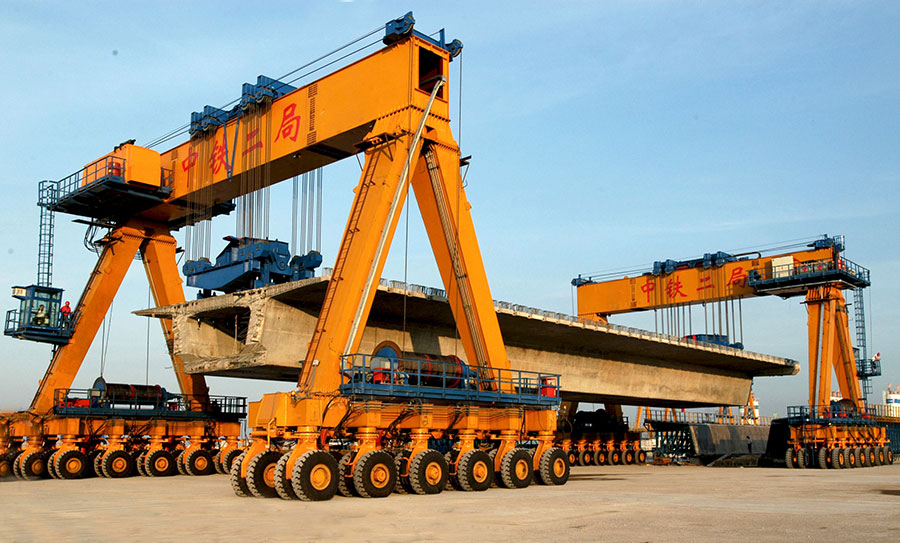
Material Flow Inside a Segmental Bridge Precast Yard
A typical segmental bridge precast yard follows a continuous production sequence rather than functioning as a simple storage area. The workflow generally includes:
- Reinforcement cage fabrication
- Formwork preparation
- Concrete casting
- Steam or natural curing
- Form removal
- Surface inspection
- Dimensional verification
- Temporary storage
- Final storage
- Loading for transportation
- Delivery to erection site
Each segment may weigh anywhere between 30 and 250 tons depending on bridge type. Metro viaduct projects often produce segments weighing around 40–80 tons, while large highway bridges and railway structures frequently exceed 100 tons.
Throughout this process, every segment must be lifted multiple times before reaching its final position in the bridge. The handling equipment therefore becomes an essential part of production rather than merely supporting logistics.
Why RTGs Are Used for Segment Storage
Large precast yards require lifting equipment capable of serving multiple storage areas without restricting future layout changes. High-capacity RTGs provide several operational advantages.
Flexible Travel Across the Yard
Unlike rail mounted gantry cranes, RTGs travel on rubber tires and do not depend on permanent rails. This flexibility allows operators to:
- Change storage zones as production increases
- Reconfigure stacking layouts during different project phases
- Expand the yard without extending rail infrastructure
- Access temporary production areas
This is particularly valuable for EPC contractors working on multiple bridge contracts with changing production requirements.
Large Working Coverage
One RTG can cover:
- Multiple storage rows
- Internal transportation lanes
- Truck loading areas
- Inspection zones
- Temporary storage locations
Depending on the span and lifting height, a single crane can replace several smaller lifting machines while maintaining continuous material flow.
Reduced Ground Infrastructure
Since no rail installation is required, site preparation is generally simplified. The yard primarily requires:
- Proper pavement strength
- Sufficient turning radius
- Drainage planning
- Flat operating surfaces
This reduces civil construction work before production begins.
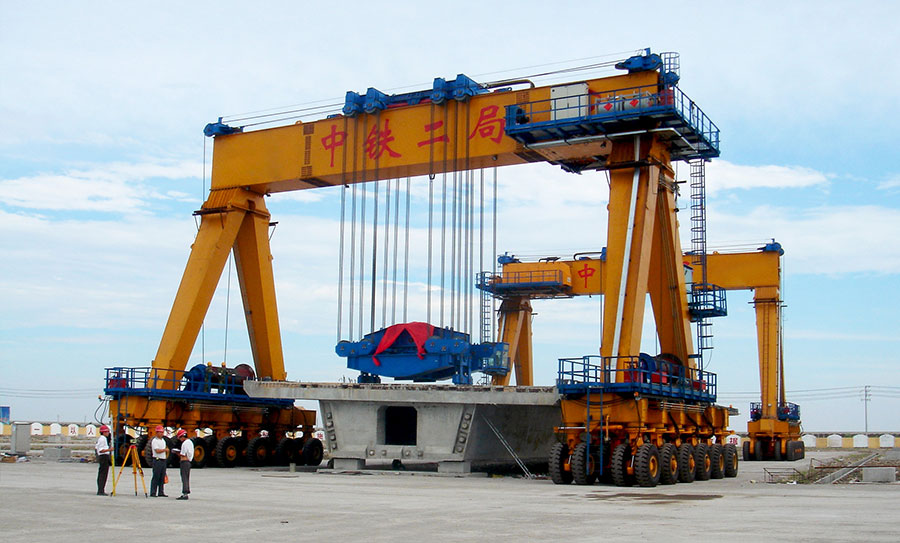
Typical Lifting Capacities for Segment Handling
RTG selection depends primarily on segment weight, lifting method, and future production plans. Typical capacities include:
| Segment Weight | Common RTG Capacity |
|---|---|
| 30–50 tons | 50 ton |
| 50–80 tons | 80 ton |
| 80–120 tons | 120–150 ton |
| 120–200 tons | 200 ton |
| Over 200 tons | Custom multi-point lifting systems |
The mobile gantry crane capacity is normally selected with consideration for:
- Lifting beam weight
- Rigging equipment
- Dynamic loads
- Wind conditions
- Future segment designs
Capacity should not be determined solely by the concrete segment weight.
Yard Layout Considerations
The productivity of an RTG depends as much on yard planning as on crane performance. Several layout parameters should be evaluated during project design.
Storage Row Width
The span of the RTG must accommodate:
- Storage lanes
- Transport vehicle clearance
- Safe operating distance
- Maintenance access
Insufficient span limits stacking flexibility. Excessively large spans increase structural weight and wheel loads. A balanced design provides adequate clearance while maintaining structural efficiency.
Stacking Height
Segment stacking height depends on:
- Segment geometry
- Storage duration
- Ground bearing capacity
- Lifting accuracy
- Safety requirements
Higher stacking increases yard capacity but also raises lifting height requirements. The RTG should provide adequate hook travel while maintaining stable lifting performance.
Traffic Separation
Production vehicles, delivery trucks, forklifts, and RTGs should follow independent travel routes whenever practical. Well-planned traffic separation reduces waiting time and minimizes interference between lifting and transportation operations.
Future Expansion
Bridge projects frequently experience design modifications or production increases. Yard layouts should allow:
- Additional storage rows
- New casting lines
- Extra curing stations
- Future RTG operating paths
Planning for expansion at the beginning often avoids significant reconstruction later.
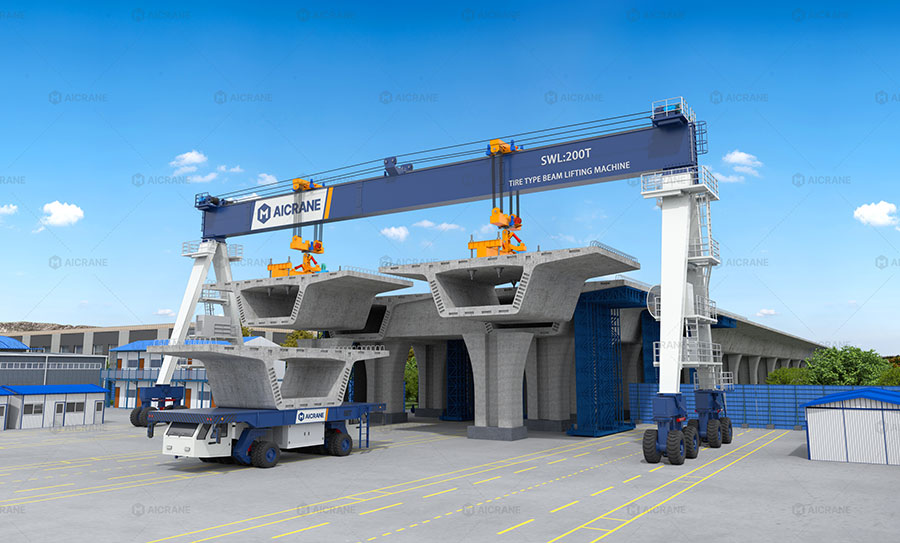
Structural Design Requirements for Heavy Concrete Handling
Handling precast bridge segments imposes different demands compared with container handling or general industrial lifting.
Box Girder Structure
High-capacity RTGs commonly use welded box-girder structures because they provide:
- High bending stiffness
- Good torsional resistance
- Stable lifting performance
- Lower structural deflection
Finite Element Analysis (FEA) is typically used during structural design to verify stress distribution and deformation under rated loads.
Multiple Wheel Assemblies
Heavy axle loads require proper weight distribution. Depending on crane capacity, RTGs may use:
- Four-wheel systems
- Eight-wheel systems
- Sixteen-wheel systems
- Multiple independently driven wheel groups
This helps reduce ground pressure while improving travel stability.
Anti-Sway Performance
Large concrete segments have significant inertia. During travel, excessive load swing can:
- Reduce positioning accuracy
- Increase handling time
- Raise collision risks
- Create unnecessary stress on rigging equipment
Drive synchronization and smooth acceleration control help minimize load movement.
Lifting Equipment for Segment Handling
The lifting device is equally important as the straddle crane itself. Most bridge segments cannot be lifted directly with hooks. Instead, projects commonly use:
- Adjustable lifting beams
- Multi-point lifting frames
- Certified lifting anchors
- Equalizing beams
- Custom spreader beams
These lifting systems distribute loads evenly while protecting the concrete from localized stress. The RTG and lifting beam should be designed as a complete lifting system rather than selected independently.
Electrical and Drive Systems
Modern RTGs typically employ variable frequency drive (VFD) technology for all major motions. Benefits include:
- Smooth acceleration
- Controlled braking
- Reduced mechanical shock
- Lower energy consumption
- More accurate positioning
Independent wheel drives improve turning performance and allow better synchronization during travel.
For projects operating in remote areas, electrical systems are often configured according to the available site power supply, while diesel-electric or hybrid drive systems may be considered where continuous grid power is unavailable.
Operational Workflow in a Precast Yard
A typical lifting cycle involves several coordinated steps.
- After curing, the concrete segment is released from the casting mold.
- The RTG positions above the lifting points.
- The lifting beam is connected to the embedded anchors.
- After inspection confirms proper rigging, the segment is lifted clear of the casting area.
- The RTG transports the segment to the designated storage location.
- The operator positions the load according to the stacking plan while maintaining alignment with supporting blocks.
- The segment remains in storage until transportation to the bridge construction site.
- The RTG later retrieves the segment for loading onto trailers or specialized transport vehicles.
Because each segment may be handled several times before installation, consistent lifting procedures help improve operational efficiency and reduce unnecessary handling.
Safety Considerations
Heavy precast concrete segments require strict operational control. Important safety practices include:
- Daily inspection of lifting beams and rigging
- Verification of lifting anchor condition
- Ground bearing capacity assessment
- Wind speed monitoring during lifting
- Travel route inspection
- Communication between signal personnel and operators
- Regular maintenance of braking and steering systems
Load charts should always reflect the actual lifting configuration, including lifting beams and rigging accessories. Operator training should also cover emergency procedures and safe handling of oversized concrete elements.
Selecting an RTG for Segmental Bridge Projects
Choosing the appropriate RTG involves more than specifying lifting capacity. Key evaluation factors include:
- Maximum segment weight
- Segment dimensions
- Planned stacking height
- Yard width and travel distance
- Daily production volume
- Ground conditions
- Future project expansion
- Local maintenance capabilities
- Power supply availability
- Environmental conditions
Early coordination between the bridge designer, precast yard planner, and crane supplier helps ensure the lifting equipment supports both current production requirements and future operational needs.
Conclusion
Efficient precast yard operations are fundamental to successful segmental bridge construction. Every concrete segment must move through production, inspection, storage, and transportation before installation, making reliable material handling essential to maintaining project schedules.
High-capacity rubber tyred gantry cranes provide the flexibility required for modern precast yards by combining heavy lifting capability with unrestricted yard mobility. Their ability to serve multiple storage areas, adapt to changing production layouts, and operate without fixed rail infrastructure makes them well suited for large bridge manufacturing facilities.
However, crane performance depends on more than lifting capacity alone. Structural design, wheel configuration, drive control, lifting devices, yard layout, traffic planning, and operational procedures all contribute to safe and efficient handling. Selecting an RTG as part of the overall precast production system, rather than as an isolated piece of equipment, helps create a material flow that supports consistent production and reliable delivery throughout the bridge construction project.