The modern boatyard is no longer a place for a homogenous fleet. Today, a typical marina must manage a diverse array of watercraft, ranging from ultra-wide catamarans and deep-keel racing sailboats to specialized commercial research vessels and high-performance powerboats. Relying on a standard, off-the-shelf marine travel lift can quickly become a bottleneck for your business. When your equipment does not fit the vessel, you risk damage to the hull, excessive strain on the travel lift, and dangerous, costly delays in your daily operations.
Customizing your equipment is not just about convenience; it is a strategic business decision. By tailoring your lifting hardware and software to meet the specific requirements of specialized vessels, you increase your yard’s throughput, reduce insurance liability, and position yourself as a facility capable of handling the most demanding projects. Whether you are dealing with small recreational boats or massive commercial vessels requiring a travel lift for sale in the 10-1200 ton range, customization is the key to unlocking new revenue streams.
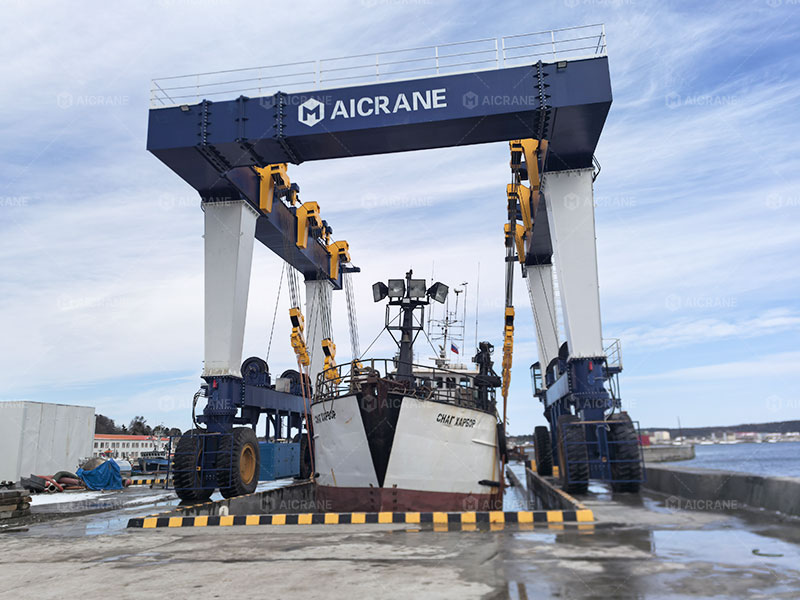
The Business Case for Customization
Standard marine lifting equipment is designed for versatility, but it is inherently limited by default geometry. When you encounter a vessel that falls outside the standard length-to-beam ratio or weight distribution, you face two choices: turn the business away or force the fit. “Forcing the fit” is where hull damage occurs. Customization allows you to adapt to the vessel rather than forcing the vessel to adapt to your equipment.
The investment in customization often pays for itself through increased billable services and the ability to win contracts for vessels that other local yards cannot safely lift. By optimizing your marina operational efficiency, you can process more vessels per quarter, significantly boosting your return on investment. Whether your facility focuses on a 10-1200 ton capacity or specialized light-duty hoisting, specialized customization ensures your yard stays ahead of the competition.
1. Sling Configurations and Load Distribution
The most frequent customization request involves the sling system. Standard slings on a typical mobile boat hoist are often positioned to handle general-purpose monohulls. However, catamarans and vessels with unconventional hull shapes require modified configurations to ensure safety and stability during vessel handling.
Adjustable Sling Spacing
Many newer travel lift models allow for mobile sling assemblies that can slide along the top beam. For a shipyard, this is the first level of customization. However, for specialized vessels, you may need additional mounting points or custom sling geometries. For instance, vessels with delicate hull coatings or non-load-bearing areas require slings that can be micro-adjusted to avoid contact with sensitive sonar equipment, transducers, or painted surfaces.
Spreader Beams and Adapters
If you frequently handle vessels with extreme beam widths or unconventional shapes, investing in custom spreader beams is essential. These beams ensure the slings hang vertically and do not pinch the hull, which is a common cause of structural damage in lighter, high-performance racing hulls. Custom adapters can also be engineered to attach to specific lifting points on specialized commercial vessels, ensuring that the lift force is applied only to the ship’s engineered structural members. Integrating these components into your boat haul-out services workflow ensures both safety and customer satisfaction.

2. Structural Dimensions and Frame Geometry
While major structural modifications are difficult after a lift is manufactured, specific parameters can be adjusted during the order phase or through authorized retrofitting.
Vertical Clearance
Sailboats with tall masts, antennas, or radar arches often struggle with standard vertical clearance. If your local market includes a high volume of sailboats, customizing the lift height is a high-value investment. Increasing the clear span height allows you to haul vessels without requiring mast removal or complex overhead maneuvering. This simplifies yacht storage operations and significantly reduces your labor costs, as your crew spends less time on rig-down procedures.
Frame Width
The rise of the catamaran has outpaced the design of many older boatyards. If your business is in an area where multi-hull popularity is growing, you may need a travel lift with an increased inner-frame width. Modifying the inner frame dimensions requires a professional engineering assessment to ensure the structural integrity of the main arch remains sound—especially when working with the 10-1200 ton class of heavy-duty equipment. Being able to lift a 30-foot-wide catamaran is a significant competitive advantage that few yards possess.
3. Control Systems and Operational Software
Mechanical hardware is only half of the customization equation. Modern mobile boat hoist units rely heavily on sophisticated control systems, which can be extensively tailored.
Remote Operation and Visibility
Standard controls are often fixed on one side of the machine. Customizing the lift with full-function wireless remote controls allows the operator to walk around the vessel during the lift. This provides a 360-degree view of the hull’s clearance and sling alignment. This level of visibility is crucial when dealing with specialized vessels that have unique appendages or shallow drafts, making it a vital component of robust boatyard safety protocols.
Precision Load Monitoring
For specialized commercial or heavy-duty vessels, load distribution is critical. Custom software can be integrated into the travel lift control system to provide real-time, precise data on the weight distribution across each sling. If the vessel is unbalanced, the system can provide visual or audible alerts before the boat is fully lifted. This prevents overloading the hydraulic system and protects the vessel from structural stress caused by uneven weight distribution.
4. The Collaborative Engineering Process
Customizing a marine travel lift is not a “DIY” project. It requires a collaborative effort between the shipyard and the boat gantry crane manufacturer. To ensure success, follow a structured process:
-
Define the Scope: Identify the specific vessels you are currently turning away or struggling to handle. Collect data on their beam, weight, and keel depth.
-
Feasibility Study: Engage the manufacturer’s engineering team. They can determine if the existing frame, hydraulics, and engine can accommodate the proposed changes without compromising safety.
-
Simulation and Design: Use modern CAD and stress-analysis software to simulate how the custom configuration will perform under load. Never skip this step; theoretical safety must be proven before physical implementation.
-
Testing and Certification: Once the custom parts are installed, the lift must undergo a rigorous load-testing protocol to ensure it remains compliant with industry safety standards and insurance requirements.
5. Maintenance and Safety Considerations
Custom equipment comes with custom maintenance requirements. If you modify your slings, frame, or lifting points, you must update your standard operating procedures.
-
Updated Load Charts: Any customization that alters the lift’s capacity must be documented with new, certified load charts. These must be clearly visible to all operators.
-
Specialized Training: Operators who are trained on standard configurations will need additional training on the nuances of the custom equipment. A wider or taller lift changes the center of gravity and the “feel” of the machine. Including this in your comprehensive marina training programs is essential for preventing accidents.
-
Preventative Inspection: Custom components, such as unique spreader bars or specialized sling mounts, will have their own wear patterns. Add these items to your daily and quarterly inspection checklists to identify fatigue early, ensuring the long-term reliability of your boatyard equipment.
Conclusion
Customizing your 10-1200 ton travel lift allows your boatyard to transcend the limitations of standard equipment. By analyzing the specialized vessels in your region and working closely with engineers to adapt your lift, you create a facility that is more efficient, safer, and capable of serving a broader market.
Whether you are managing a 10-1200 ton fleet or specializing in niche high-performance racing craft, the ability to tailor your equipment is a major asset. Focus on the details—sling configuration, vertical clearance, and operator visibility—and your yard will be equipped to handle almost anything that comes down the channel.