Installing a 50 ton gantry crane requires a rail system designed to support the crane’s maximum wheel loads, operating forces, travel requirements, and site conditions. The rails must provide a stable, level, and accurately aligned running surface for the crane throughout its operating range. Key requirements include adequate rail strength, proper rail gauge, sufficient foundation capacity, controlled elevation and alignment, reliable rail fastening, and effective drainage.
For a 50 ton gantry crane, rail selection cannot be based on lifting capacity alone. The total crane weight, trolley and hoist weight, wheel arrangement, maximum wheel loads, span, duty class, travel speed, and operating environment all affect rail design. The crane manufacturer and civil engineering team should coordinate these parameters before construction begins to avoid excessive wheel loads, uneven travel, structural damage, and costly installation modifications.
1. What Rail System Does a 50 Ton Gantry Crane Require?
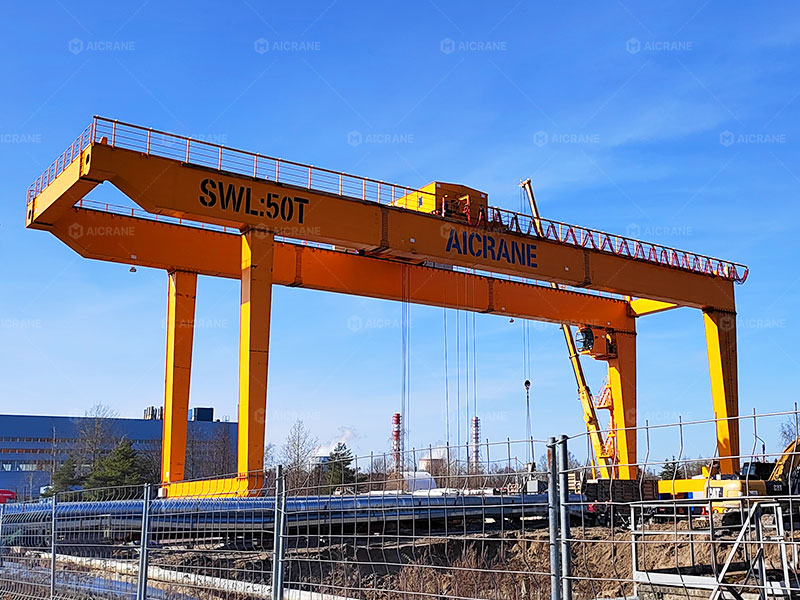
A 50 ton gantry crane generally operates on two parallel ground-mounted rails installed along its travel path. The crane’s legs are supported by end carriages equipped with travel wheels that run on these rails.
The rail system transfers the combined loads from the crane structure, lifting equipment, and suspended load into the supporting foundation and ground.
A typical installation includes:
- Crane rails: Steel rails that provide the running surface for crane wheels.
- Rail clips and fastening systems: Components that secure the rails while allowing for appropriate installation tolerances and thermal movement.
- Concrete rail foundations: Reinforced concrete beams or foundations that distribute wheel loads into the ground.
- Rail pads: Optional components installed between the rail and supporting structure to distribute contact pressure and reduce vibration.
- Grouting and leveling materials: Used where required to achieve the specified rail elevation and supporting contact.
- Drainage provisions: Systems that prevent standing water around the rail foundations.
For a 50 ton gantry crane, the two rails must maintain the specified gauge and alignment throughout the full travel distance. Any significant deviation can cause uneven wheel loading, increased flange contact, accelerated wheel and rail wear, or travel system problems.
The exact rail arrangement depends on whether the crane is a single-girder or double-girder design, its wheel configuration, and the manufacturer’s structural requirements.
2. How to Select the Right Rail Type for a 50 Ton Gantry Crane?
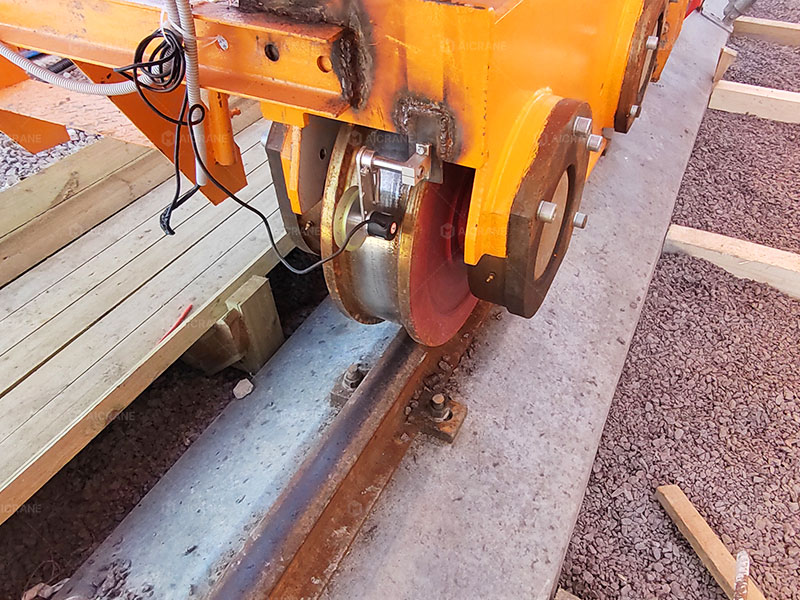
Rail selection is one of the most important decisions during gantry crane installation. The selected rail must withstand the maximum wheel loads and repeated operating cycles without excessive deformation or premature wear.
2.1 Crane Rail Profiles
Industrial gantry cranes commonly use specialized crane rails or other engineered steel rail sections.
Common options include:
- Crane rails: Designed for heavy wheel loads and industrial gantry crane applications, with profiles selected according to wheel contact conditions and structural requirements.
- Square or rectangular steel bars: Used in certain lighter-duty or specially engineered installations, provided their strength and contact geometry meet the design requirements.
- Standard railway rails: May be suitable for some crane installations when their dimensions, material properties, and wheel contact conditions are verified by engineering calculations.
For a 50 ton gantry crane, a dedicated crane rail is often considered because of its suitability for repeated heavy wheel loading.
However, there is no universal rail profile for every 50 ton crane. The final selection must be based on the actual maximum wheel load, wheel diameter, wheel tread width, rail material, and supporting foundation design.
2.2 Rail Size and Load Capacity
A common mistake is selecting a rail simply because it is used on another crane with the same rated lifting capacity.
Two 50 ton gantry cranes can have significantly different rail requirements because of differences in:
- Crane dead weight.
- Number and arrangement of traveling wheels.
- Maximum wheel load.
- Crane span and leg spacing.
- Trolley and hoist configuration.
- Operating duty class.
- Travel and braking forces.
For example, a double-girder 50 ton gantry crane with a large span and heavy steel structure may produce different wheel loads from a more compact configuration.
The rail must be checked for bending stress, contact stress, local deformation, and compatibility with the supporting foundation.
The gantry crane supplier should provide the maximum wheel load for each rail, including the relevant operating and dynamic conditions, so that the civil engineer can verify the rail and foundation design.
3. What Are the Rail Gauge Requirements for a 50 Ton Gantry Crane?
Rail gauge refers to the horizontal distance between the centerlines of the two parallel rails.
For a gantry crane, the rail gauge must match the distance between the corresponding wheel running lines on the crane’s two end carriages.
Unlike railway systems, gantry crane rail gauge is generally determined by the crane’s structural design and operating requirements.
A 50 ton gantry crane may have different spans depending on the working area, building layout, material handling requirements, and lifting configuration. Therefore, its rail gauge must be confirmed from the approved crane general arrangement drawing.
3.1 Why Is Rail Gauge Accuracy Important?
Incorrect rail gauge can create several operational problems:
- Excessive wheel loading: Differences between the actual and designed gauge can cause uneven loading across the traveling wheels.
- Wheel flange wear: Misalignment may increase contact between wheel flanges and rail sides.
- Travel resistance: Incorrect spacing can increase resistance and affect rail gantry crane movement.
- Structural stress: Forced alignment between the crane legs and rails can introduce additional stresses into the end carriages and supporting structure.
3.2 Maintaining the Correct Rail Gauge
During installation, the distance between the rail centerlines should be measured at multiple positions along the entire travel path.
The installation team should:
- Establish a fixed survey reference line.
- Mark the centerline of each rail.
- Measure the gauge at regular intervals.
- Check the gauge at rail joints and foundation transitions.
- Correct deviations before final rail fastening.
- Record the final measurements for inspection.
The allowable gauge deviation should follow the crane manufacturer’s installation drawings and applicable engineering standards. A single universal tolerance should not be assumed for all 50 ton gantry cranes.
4. What Foundation Requirements Are Needed for Gantry Crane Rails?
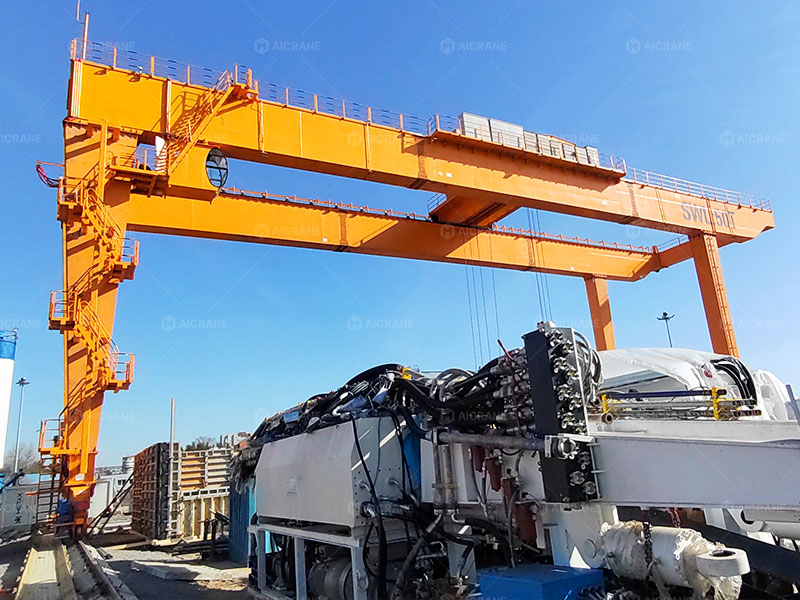
Rail foundations must support repeated concentrated wheel loads and transfer them safely into the ground.
For a 50 ton gantry crane, reinforced concrete rail beams are commonly used, especially in permanent outdoor industrial installations.
The foundation design must consider more than the crane’s 50 ton rated lifting capacity. It must account for the maximum wheel loads, crane self-weight, dynamic effects, braking forces, lateral forces, and ground conditions.
4.1 Reinforced Concrete Rail Beams
A reinforced concrete rail beam provides a stable base for the crane rail and distributes concentrated loads along the supporting structure.
Its design should consider:
- Concrete strength.
- Beam width and depth.
- Reinforcement arrangement.
- Maximum wheel load and wheel spacing.
- Soil bearing capacity.
- Differential settlement.
- Anchor and fastening details.
- Environmental exposure.
The dimensions and reinforcement cannot be determined from lifting capacity alone. A geotechnical investigation and structural calculation are necessary for reliable foundation design.
4.2 Soil Bearing Capacity
Ground conditions have a direct impact on rail foundation performance.
Weak or uneven soil may lead to differential settlement, resulting in rail elevation differences and alignment problems.
Before construction, the project team should evaluate:
- Soil type and bearing capacity.
- Groundwater conditions.
- Existing underground utilities.
- Previous ground settlement.
- Compaction requirements.
- Potential soil movement caused by seasonal temperature or moisture changes.
For installations on reclaimed land, soft soil, or industrial yards with variable ground conditions, additional ground improvement or deeper foundation solutions may be necessary.
4.3 Foundation Level and Elevation
Both rail foundations should maintain the required elevation along the crane’s full travel distance.
Uneven foundations can cause the crane to travel with an unintended inclination or experience uneven wheel loading.
Survey measurements should verify:
- Longitudinal elevation of each rail beam.
- Relative elevation between the two rails.
- Foundation straightness.
- Rail support continuity.
- Local settlement or surface irregularities.
Foundation acceptance should take place before rail installation.
5. What Rail Alignment Tolerances Should Be Considered?
Rail alignment is critical to the safe and reliable operation of a 50 ton gantry crane.
Even when the rail profile and foundation strength are adequate, poor alignment can cause excessive mechanical loads and premature component wear.
Three main alignment parameters require attention.
5.1 Straightness
Rail straightness refers to how closely the rail follows its specified longitudinal centerline.
The rail should remain straight over the full crane travel distance. Local deviations can cause wheel flange contact and irregular movement.
Survey instruments should be used to check rail alignment before final fastening and during commissioning.
5.2 Elevation Difference
The elevation of the two rails should be controlled to prevent unintended cross-slope conditions.
An excessive elevation difference may cause uneven loading between the crane legs and increase structural stress.
The acceptable difference depends on the crane design, rail gauge, and manufacturer requirements.
5.3 Rail Joint Alignment
Rail joints should provide a smooth transition between adjacent rail sections.
Poorly installed joints may produce impact loads as crane wheels pass over them.
Important considerations include:
- Correct rail end positioning.
- Controlled joint gaps where specified.
- Proper alignment of rail heads.
- Suitable fastening at joint locations.
- Appropriate joint welding or mechanical connection methods.
The joining method should follow the rail manufacturer’s specifications and the approved installation procedure.
6. How Should Rails Be Fixed to the Foundation?
Rail fastening systems secure the rails and maintain their designed position under operating loads.
For a 50 ton gantry crane, the fastening arrangement must resist vertical loads, lateral forces, braking forces, and repeated movement-induced vibration.
Common fastening components include:
- Rail clips.
- Anchor bolts.
- Base plates.
- Rail pads.
- Grout or leveling materials.
6.1 Rail Clips
Rail clips are commonly used to secure crane rails to their supporting structures.
Depending on the design, clips may provide lateral restraint while allowing limited longitudinal movement to accommodate thermal expansion.
The clip type, spacing, and tightening requirements must be specified by the crane or rail system designer.
6.2 Anchor Bolts and Base Plates
Anchor bolts transfer fastening forces into the concrete foundation.
Their diameter, embedment depth, spacing, and material should be determined by engineering calculations.
Where base plates are used, they must provide adequate support and maintain the specified rail elevation.
6.3 Rail Welding
Some installations use welded rail joints or welded fastening details.
Welding must be performed according to an approved procedure and by qualified personnel. Incorrect welding can introduce residual stress, deformation, or cracking.
For rails subject to temperature changes, the design must also consider thermal expansion and the appropriate joint arrangement.
7. What Additional Requirements Apply to Outdoor Gantry Crane Rails?
Outdoor installations introduce additional environmental and operational factors.
A 50 ton gantry crane operating in a port, steel yard, precast concrete facility, or open industrial storage area may be exposed to rain, dust, temperature changes, and wind.
The rail infrastructure should address these conditions.
7.1 Drainage
Water accumulation around rail foundations can weaken supporting soil, accelerate corrosion, and create maintenance problems.
The installation should include suitable drainage slopes, drainage channels, or other water management provisions.
The drainage arrangement must not interfere with rail fastening or crane wheel movement.
7.2 Corrosion Protection
Rails, clips, bolts, and exposed steel components may require protective coatings or suitable corrosion-resistant materials.
The protection system should reflect the operating environment, particularly in coastal and marine locations where salt exposure can accelerate corrosion.
7.3 Wind Protection
Outdoor gantry cranes may experience substantial wind forces when parked or operating.
The crane and its supporting rail system must be designed for the applicable wind conditions.
Depending on the crane design, safety provisions may include:
- Rail clamps.
- Storm brakes.
- Wheel locks.
- Wind anchoring devices.
The rail foundation and associated anchoring points must be capable of transferring the specified wind and restraint forces.
8. How to Prepare the Site Before Installing 50 Ton Gantry Crane Rails?
Proper site preparation reduces installation risks and helps ensure that the crane can operate as designed.
The following sequence is commonly used for permanent rail-mounted gantry crane installations.
Step 1: Review the crane drawings
Confirm the crane span, rail gauge, overall travel distance, wheel arrangement, maximum wheel loads, and foundation interface requirements.
Step 2: Conduct a site survey
Check ground conditions, existing structures, underground utilities, drainage, and available installation space.
Step 3: Complete foundation engineering
Calculate the reinforced concrete beam dimensions, reinforcement, bearing capacity, and anchoring arrangements.
Step 4: Construct the rail foundations
Excavate, prepare the subgrade, install reinforcement, and pour concrete according to approved construction drawings.
Step 5: Verify foundation acceptance
Check concrete strength, foundation elevation, straightness, and anchor positions before installing the rails.
Step 6: Install and align the rails
Position the rails, adjust the gauge and elevation, install fastening components, and inspect all rail joints.
Step 7: Conduct final inspection
Verify rail alignment, fastening security, joint conditions, and travel path clearance before crane installation and commissioning.
This sequence should be coordinated with the crane manufacturer’s installation requirements and the project’s construction schedule.
9. How to Inspect and Maintain Gantry Crane Rails After Installation?
Rail inspection should continue throughout the crane’s operating life.
A 50 ton gantry crane can generate repeated wheel loads during lifting, traveling, and braking. Over time, rail wear, loose fasteners, settlement, and joint damage may affect operating performance.
A practical rail inspection program should include the following items.
| Inspection Item | What to Check | Potential Problem |
|---|---|---|
| Rail surface | Wear, cracks, deformation | Increased wheel wear |
| Rail alignment | Straightness and gauge | Uneven travel |
| Rail elevation | Settlement and level differences | Uneven wheel loading |
| Rail joints | Gaps, steps, and damage | Wheel impact |
| Rail clips | Looseness or damage | Rail displacement |
| Anchor bolts | Corrosion and loosening | Reduced fastening reliability |
| Concrete foundation | Cracks and settlement | Loss of structural support |
| Drainage | Standing water and blocked channels | Foundation deterioration |
Inspection frequency should be determined by operating hours, duty class, environmental conditions, and applicable maintenance standards.
Additional inspections are advisable after foundation repairs, significant weather events, abnormal crane movement, or suspected derailment incidents.
Any abnormal rail condition should be evaluated before the crane continues normal operation.
10. What Information Is Needed to Design Rails for a 50 Ton Gantry Crane?
To determine the correct rail profile, foundation arrangement, and installation requirements, the crane manufacturer and civil engineering team need specific project information.
The following details are particularly important:
| Required Information | Why It Matters |
|---|---|
| Rated lifting capacity | Establishes the lifting load |
| Crane span | Determines the distance between supporting legs |
| Rail gauge | Defines the spacing between running rails |
| Crane dead weight | Contributes to wheel loads |
| Maximum wheel load | Determines rail and foundation design loads |
| Number of wheels | Affects load distribution |
| Travel distance | Determines rail length and foundation arrangement |
| Duty class | Influences fatigue and operating requirements |
| Operating environment | Affects corrosion, wind, and drainage provisions |
| Ground conditions | Determines foundation design |
For example, a 50 ton double-girder gantry crane used in a precast concrete yard may require a different rail and foundation arrangement from a crane handling steel materials in an outdoor storage facility.
The difference may come from crane weight, span, wheel configuration, operating frequency, travel distance, and ground conditions rather than lifting capacity alone.
11. Frequently Asked Questions About 50 Ton Gantry Crane Rail Installation
What size rail is required for a 50 ton gantry crane?
There is no universal rail size for a 50 ton gantry crane. The correct profile depends on maximum wheel load, wheel diameter, wheel arrangement, rail material, and foundation conditions. The crane manufacturer should provide the required wheel load data for rail selection.
How far apart should the two gantry crane rails be?
The rail spacing must match the designed crane gauge. It is determined by the crane span and structural arrangement, not by the 50 ton lifting capacity alone. Always use the approved general arrangement drawing.
Does a 50 ton gantry crane require reinforced concrete foundations?
Most permanent heavy-duty installations use engineered reinforced concrete rail foundations or another suitable structural support system. The final solution depends on ground conditions, wheel loads, crane configuration, and operating requirements.
Can existing rails be reused for a new 50 ton gantry crane?
Existing rails may be reused if their profile, condition, gauge, alignment, foundation capacity, and fastening arrangements meet the new crane’s requirements. A qualified engineer should inspect and verify the entire rail system before reuse.
How long should the rail foundation be?
The rail foundation should cover the crane’s full required travel path, including any additional length needed for end stops, parking positions, and operational clearances. The exact length depends on the crane layout and project requirements.
Who is responsible for designing the gantry crane rail foundation?
The crane manufacturer typically provides crane interface information, including maximum wheel loads, rail gauge, and rail requirements. The project’s civil or structural engineering team uses these details together with geotechnical data to design the foundation and supporting structure.
Conclusion
Rail requirements for a 50 ton gantry crane involve coordinated engineering of the rail profile, gauge, foundation, alignment, fastening system, and environmental protection. The most important starting point is obtaining the crane’s actual maximum wheel loads and approved rail layout rather than selecting rails based only on the rated lifting capacity.
For a reliable installation, crane manufacturers, civil engineers, and installation contractors should coordinate the rail and foundation design before construction begins. Proper surveying, alignment checks, fastening inspections, and ongoing maintenance help maintain stable crane travel and reduce premature wear.
When planning a 50 ton gantry crane installation, provide the crane span, lifting height, travel distance, wheel load information, and site conditions to the equipment supplier. These details allow the rail and foundation requirements to be evaluated against the actual operating conditions.