Lifting steel coils safely with a 25 ton gantry crane requires more than selecting a crane with sufficient rated capacity. The lifting system must account for coil weight, diameter, width, center of gravity, lifting method, attachment capacity, and ground conditions. For most steel coil handling operations, a properly configured 25 ton gantry crane can handle coils weighing up to its rated capacity, provided the complete lifting arrangement is approved for the load and operating conditions.
The safest approach is to use a suitable coil lifting attachment, such as a C-hook, coil tong, or lifting beam, depending on coil orientation and handling requirements. Operators must also verify the crane’s load chart, inspect lifting accessories, control load movement, and follow an established lifting procedure.
This guide explains how to select, configure, and operate a 25 ton gantry crane for steel coil handling while reducing the risks of dropped loads, equipment damage, and workplace accidents.
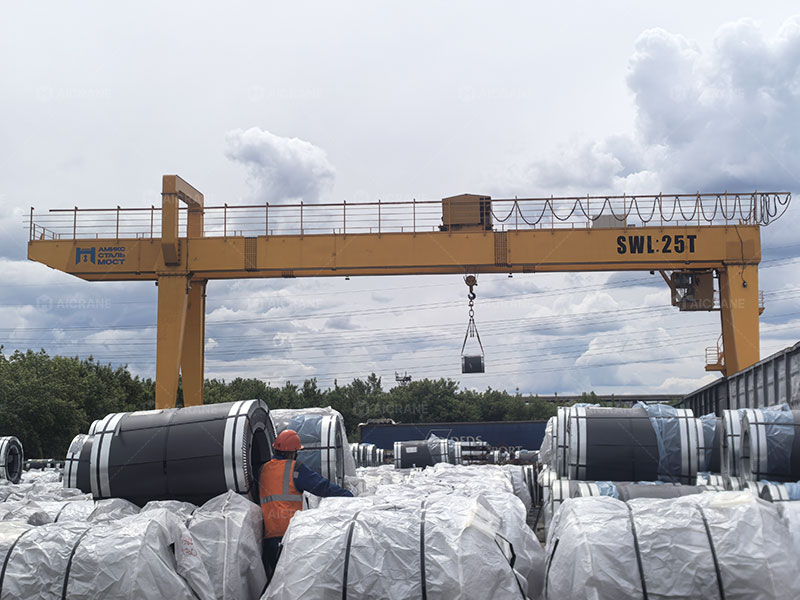
1. Is a 25 Ton Gantry Crane Suitable for Steel Coil Handling?
A 25 ton gantry crane is suitable for handling steel coils when the maximum coil weight and the total suspended load remain within the crane’s rated capacity.
Steel coils vary considerably in weight and dimensions. A small coil may weigh several tons, while large industrial coils used in steel processing facilities can approach or exceed 25 tons.
Before selecting a crane, buyers should evaluate three important factors:
- Coil weight: The maximum weight of an individual coil, including any packaging or attached components.
- Lifting configuration: The weight of the lifting beam, C-hook, coil tong, slings, and other accessories.
- Operating conditions: The lifting height, span, working frequency, travel distance, and required positioning accuracy.
For example, if a steel coil weighs 22 tons and the lifting attachment weighs 1 ton, the total suspended load is approximately 23 tons. The crane’s capacity and applicable rating rules must accommodate this arrangement.
A 25 ton crane should not automatically be assumed suitable for every 22–25 ton coil. The manufacturer must confirm whether the rated capacity includes the lifting accessories and whether any configuration-specific restrictions apply.
Typical Steel Coil Handling Applications
A 25 ton gantry crane can serve several industrial applications:
| Application | Typical Handling Requirements |
|---|---|
| Steel warehouses | Loading, unloading, and stacking steel coils |
| Steel service centers | Moving coils between storage and processing areas |
| Rolling mills | Transferring coils between production stages |
| Metal processing plants | Feeding decoiling and slitting lines |
| Port storage yards | Handling steel coils during cargo transfer |
The appropriate crane configuration depends on whether coils are stored horizontally or vertically, how frequently they are moved, and whether the crane operates indoors or outdoors.
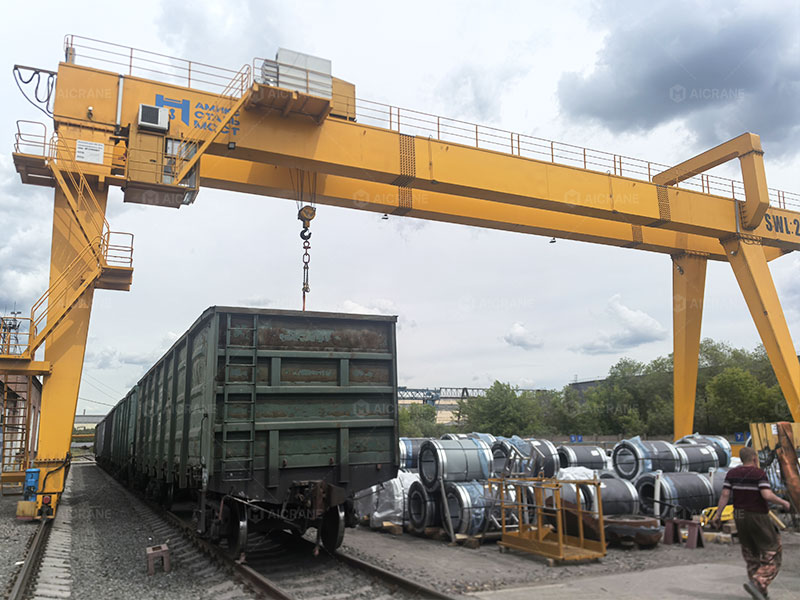
2. What Is the Best Lifting Attachment for Steel Coils?
The lifting attachment is one of the most important components in safe steel coil handling. Different attachments support different coil orientations and handling conditions.
The three common options are C-hooks, coil tongs, and lifting beams.
2.1 C-Hook for Horizontal Steel Coils
A C-hook is widely used for lifting steel coils with a horizontal eye, where the coil axis is horizontal and the hook enters the central opening.
Its curved lower arm supports the coil from underneath, while the upper arm provides a counterbalancing structure.
Advantages:
- Suitable for frequent steel coil handling.
- Allows relatively quick engagement and release.
- Requires no complex clamping mechanism.
- Can be designed for different coil diameters and widths.
Limitations:
- The coil must have sufficient internal clearance for the hook.
- The hook dimensions must match the coil’s inner diameter and width.
- Improper positioning can cause unstable lifting or coil damage.
A C-hook should be designed according to the coil’s dimensions, weight, and center of gravity rather than selected by capacity alone.
2.2 Coil Tong for Vertical Steel Coils
Coil tongs are commonly used when steel coils are stored or handled with a vertical eye.
They grip the coil through a mechanical or hydraulic clamping mechanism, depending on the design.
Advantages:
- Suitable for vertical-eye coil handling.
- Can reduce manual positioning during engagement.
- Some designs allow controlled gripping and release.
Limitations:
- The gripping force must be suitable for the coil.
- Incorrect gripping pressure may damage the coil edges or surface.
- Mechanical and hydraulic systems require regular inspection.
Coil tongs must be specifically designed for the coil dimensions, weight, and material characteristics.
2.3 Lifting Beam with Slings
A lifting beam distributes the load between multiple lifting points and can be used with suitable slings or other attachments.
It is useful when handling different coil sizes or when the lifting arrangement requires a specific load distribution.
Advantages:
- Flexible lifting configurations.
- Can accommodate different coil dimensions.
- Helps control sling geometry and load distribution.
Limitations:
- Additional equipment increases the suspended load.
- Sling angles affect individual sling forces.
- The arrangement requires engineering verification.
Comparison of Steel Coil Lifting Attachments
| Attachment | Suitable Coil Orientation | Main Application |
|---|---|---|
| C-hook | Horizontal eye | Warehouse and production handling |
| Coil tong | Vertical eye | Vertical coil handling |
| Lifting beam | Depends on configuration | Flexible lifting arrangements |
The attachment must be compatible with the coil and approved for the intended lifting configuration. Operators should never substitute an ordinary hook or improvised sling arrangement for a purpose-designed coil lifting device.
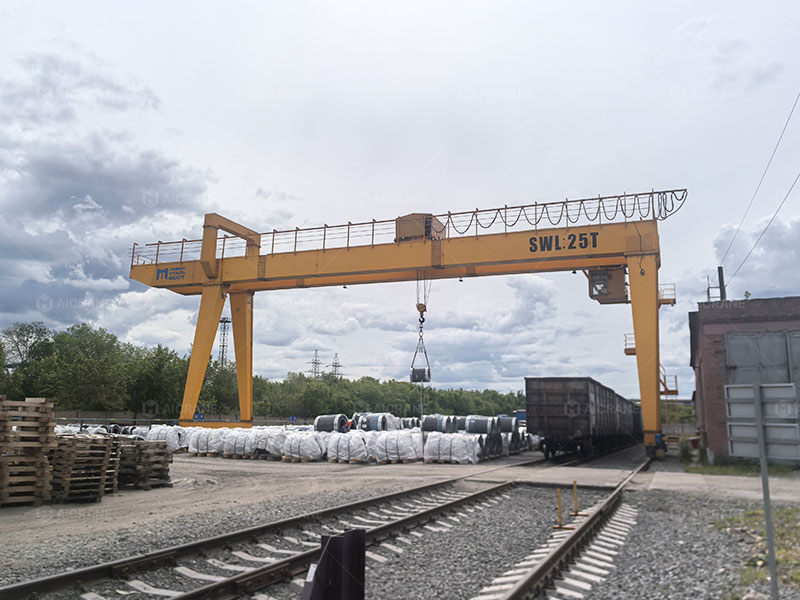
3. How to Calculate the Required Lifting Capacity
Correct capacity calculation is essential when selecting a 25 ton gantry crane.
The first step is to identify the maximum coil weight. The second is to account for the lifting accessories and any other suspended components.
A basic calculation is:
Total suspended load = Coil weight + Lifting attachment weight + Other suspended equipment weight
For example:
| Component | Weight |
|---|---|
| Steel coil | 22 tons |
| C-hook | 1 ton |
| Additional lifting accessories | 0.3 tons |
| Total suspended load | 23.3 tons |
This example shows that the lifting arrangement carries 23.3 tons rather than just the 22 ton coil.
However, capacity interpretation depends on the crane design and applicable standards. Some crane ratings account for the hook block and integral lifting equipment differently. Buyers must confirm the manufacturer’s rated-capacity definition and avoid double-counting or omitting components.
Why Should Buyers Avoid Operating at Maximum Capacity All the Time?
Regular operation close to the rated gantry crane capacity can increase equipment loading and leave little flexibility for variations in load weight or handling conditions.
A 25 ton gantry crane is not automatically suitable for continuous handling of 25 ton coils.
For example, a steel service center that regularly handles coils weighing 22–24 tons should evaluate whether a higher-capacity crane would provide a more appropriate operating margin.
The selection should consider:
- Maximum and average coil weights.
- Daily lifting frequency.
- Duty classification.
- Acceleration and braking requirements.
- Attachment weight.
- Future production expansion.
The crane manufacturer should verify the complete lifting configuration rather than relying on nominal capacity alone.
4. What Crane Specifications Matter for Steel Coil Handling?
Crane capacity is only one part of the equipment selection process. Span, lifting height, travel speed, duty classification, and control systems also influence operational safety and productivity.
4.1 Rated Lifting Capacity
A 25 ton rating establishes the crane’s nominal lifting capacity under its specified operating conditions.
Buyers should confirm that the selected crane can safely handle the maximum coil and attachment combination.
4.2 Span
The span is the horizontal distance between the centerlines of the gantry crane’s supporting legs or wheels, depending on the design.
It should match the working area and storage layout.
For example, a steel warehouse with two storage rows and a central processing line may require a wider span to cover all handling positions.
An incorrectly selected span can create inaccessible storage areas or interfere with production equipment.
4.3 Lifting Height
Lifting height determines how high the coil can be raised.
It should account for:
- Maximum coil stacking height.
- Truck or trailer loading height.
- Processing equipment feeding height.
- Required clearance above the load.
- Hook block and attachment dimensions.
The required lifting height should be calculated based on the complete lifting arrangement, not simply the height of the steel coil.
4.4 Working Duty Classification
Duty classification indicates the crane’s intended operating intensity.
A warehouse that handles several coils per shift may have different requirements from a steel mill that transfers coils continuously throughout production.
The appropriate duty classification depends on load spectrum, operating cycles, and working frequency.
The manufacturer should select the hoisting mechanism, motors, brakes, and structural components accordingly.
4.5 Hoisting and Traveling Speeds
Appropriate speeds help operators position heavy steel coils accurately.
Important speed parameters include:
- Hoisting speed.
- Trolley traveling speed.
- Gantry traveling speed.
Variable-frequency drives can provide controlled acceleration and deceleration, helping reduce sudden load movements.
For precision coil positioning, buyers should also consider low-speed operation and inching control.
4.6 Safety and Control Systems
A 25 ton gantry crane may incorporate:
- Overload protection.
- Upper and lower hoisting limit switches.
- Emergency stop controls.
- Travel limit switches.
- Audible and visual warning devices.
- Anti-collision protection where multiple cranes operate on the same runway or working area.
- Electrical protection and fault monitoring.
The exact safety configuration depends on the crane design, applicable regulations, and project requirements.
5. How to Lift Steel Coils Safely: A Step-by-Step Procedure
A standardized lifting procedure helps operators control the main risks associated with steel coil handling.
Step 1: Inspect the Crane Before Operation
Before lifting, operators should inspect the crane and its critical components.
Check:
- Main girder and supporting structures for visible damage.
- Wire ropes or chains for wear and deformation.
- Hooks and lifting attachments for cracks or abnormal wear.
- Brakes and hoisting mechanisms.
- Limit switches and overload protection.
- Electrical controls and emergency stop functions.
- Wheels, rails, and traveling mechanisms.
Any defect that could affect safe operation must be addressed before lifting begins.
Step 2: Verify the Steel Coil Weight and Dimensions
Confirm the coil’s actual weight using reliable production records, weighing information, or other approved documentation.
Check the following dimensions:
- Outer diameter.
- Inner diameter.
- Coil width.
- Coil orientation.
- Packaging and edge protection.
These measurements determine whether the selected lifting attachment can safely engage the coil.
Never estimate coil weight solely from its appearance.
Step 3: Select and Inspect the Lifting Attachment
Choose a C-hook, coil tong, or lifting beam based on the coil orientation and handling requirements.
Before use, verify:
- The attachment’s rated working load limit.
- Compatibility with the coil dimensions.
- Correct engagement points.
- Structural integrity.
- Condition of locking and gripping mechanisms.
- Inspection and maintenance records.
The attachment must be properly secured to the crane hook or lifting arrangement.
Step 4: Position the Crane Directly Above the Load
Move the crane and trolley into the correct lifting position.
The hook should be aligned with the load’s center of gravity to minimize side loading and unwanted swinging.
Operators should avoid lifting coils at an angle or pulling them horizontally with the hoist.
Side pulling can introduce forces that the crane and hoisting system are not designed to withstand.
Step 5: Engage the Steel Coil Correctly
For a C-hook, insert the supporting arm through the coil’s central opening and position it according to the attachment manufacturer’s instructions.
For coil tongs, ensure the gripping mechanism engages the designated lifting area.
For a lifting beam, confirm that all slings and connection points are correctly positioned.
Keep personnel clear of the load and lifting zone during engagement.
Step 6: Perform a Test Lift
Raise the coil a short distance above its supporting surface.
Pause and verify:
- The load is balanced.
- The attachment is correctly engaged.
- The coil remains stable.
- The brakes hold the load.
- No abnormal noises or movements occur.
If the coil tilts, shifts, or becomes unstable, lower it safely and correct the lifting arrangement.
A test lift is an important opportunity to identify problems before transporting the coil.
Step 7: Move the Load at a Controlled Speed
Once the load is stable, move the trolley and gantry crane smoothly.
Operators should:
- Avoid sudden acceleration or braking.
- Maintain a clear travel path.
- Avoid moving over personnel.
- Keep the load at the minimum practical height during travel.
- Maintain communication with ground personnel.
- Prevent collisions with storage racks and production equipment.
Steel coils have substantial mass and can generate dangerous impact forces if allowed to swing.
Step 8: Lower and Release the Coil Carefully
Position the coil over its designated storage area or equipment.
Lower it slowly onto a stable support designed for the coil’s weight and geometry.
Before releasing the lifting attachment, confirm that the coil is fully supported and cannot roll, slide, or tip.
For stacked coils, verify that the storage arrangement is stable and consistent with the facility’s approved stacking procedure.
6. What Are the Main Safety Risks When Handling Steel Coils?
Steel coils are heavy, compact loads with potentially unstable handling characteristics. Their cylindrical shape creates additional risks compared with lifting regular rectangular materials.
Load Swinging
Load swinging can occur because of sudden crane acceleration, braking, or incorrect lifting alignment.
Prevention: Use controlled traveling speeds, avoid sudden movements, and position the hook directly above the load’s center of gravity.
Coil Slipping or Falling
An incorrectly selected attachment or improper engagement can cause the coil to slip during lifting.
Prevention: Use purpose-designed coil lifting equipment and verify engagement before moving the load.
Coil Rolling
When a coil is placed on an unsuitable surface, it may roll unexpectedly.
Prevention: Use properly designed coil saddles, chocks, or storage supports appropriate for the coil dimensions and weight.
Overloading
Incorrect weight information or failure to include lifting accessories can result in overload conditions.
Prevention: Verify the complete suspended load and follow the crane manufacturer’s rated-capacity requirements.
Collision and Pinch Hazards
Moving coils can strike equipment, storage racks, or nearby personnel.
Prevention: Establish exclusion zones, maintain clear travel paths, and use trained signalers where necessary.
Ground or Foundation Failure
Outdoor gantry cranes transfer substantial loads through their wheels to the ground or supporting rails.
Weak or uneven ground can cause differential settlement, instability, or excessive wheel loading.
Prevention: Verify ground-bearing capacity, rail alignment, drainage, and foundation design before commissioning the crane.
7. Indoor vs. Outdoor 25 Ton Gantry Cranes for Steel Coil Handling
The working environment affects crane configuration, structural design, and maintenance requirements.
| Factor | Indoor Operation | Outdoor Operation |
|---|---|---|
| Weather exposure | Generally protected | Exposed to rain, wind, and temperature changes |
| Ground support | Concrete floor or rails | Engineered rails or supporting foundations |
| Corrosion protection | Depends on indoor conditions | Requires suitable environmental protection |
| Wind considerations | Usually less significant | Important during operation and shutdown |
| Travel layout | Defined production or warehouse area | May cover open storage yards |
| Electrical protection | Based on indoor environment | Requires suitable weather protection |
For indoor steel warehouses, the warehouse gantry crane layout should support efficient movement between receiving, storage, and processing areas.
For outdoor steel storage yards, buyers should pay particular attention to wind conditions, wheel loads, rail foundations, drainage, and storm protection.
Outdoor gantry cranes may require wind-resistant operating arrangements and storm anchoring systems according to the project design and applicable standards.
8. How to Maintain a 25 Ton Gantry Crane for Reliable Steel Coil Handling
Regular maintenance helps identify defects before they affect lifting safety or equipment availability.
A maintenance program should cover mechanical, electrical, structural, and lifting components.
| Component | Inspection Focus |
|---|---|
| Wire ropes | Broken wires, corrosion, deformation, and lubrication |
| Hooks | Cracks, deformation, and safety latch condition |
| Brakes | Braking performance and wear |
| Hoisting motor | Temperature, vibration, and abnormal noise |
| Gearbox | Lubrication, leakage, and unusual operating sounds |
| Wheels | Wear, alignment, and surface condition |
| Rails | Alignment, joints, and supporting condition |
| Electrical system | Wiring, protection devices, and control functions |
| Lifting attachments | Cracks, deformation, and connection integrity |
Inspection frequency should be established according to applicable regulations, manufacturer recommendations, operating intensity, and environmental conditions.
Daily pre-use checks should be distinguished from periodic detailed inspections and preventive maintenance.
Any safety-critical defect should result in the equipment being taken out of service until it has been properly assessed and repaired.
9. How to Choose the Right 25 Ton Gantry Crane for Your Steel Coil Warehouse
Selecting the right crane requires evaluating the entire material-handling process rather than focusing only on lifting capacity.
Industrial buyers should prepare the following information before requesting a quotation.
| Selection Factor | Information to Prepare |
|---|---|
| Rated capacity | Maximum steel coil weight |
| Coil dimensions | Inner diameter, outer diameter, and width |
| Lifting orientation | Horizontal eye or vertical eye |
| Lifting attachment | C-hook, coil tong, or lifting beam |
| Span | Required working coverage |
| Lifting height | Maximum required hook lifting height |
| Working duty | Lifting frequency and operating hours |
| Traveling distance | Required trolley and gantry travel |
| Working environment | Indoor or outdoor |
| Power supply | Available voltage and frequency |
| Control method | Pendant, radio remote, or cabin control |
| Safety requirements | Applicable local standards and protection systems |
Why Is Coil Diameter Important?
Coil diameter directly affects lifting attachment geometry and the available engagement space.
For example, a C-hook designed for a coil with a large inner diameter may not fit a smaller coil.
Similarly, the hook’s supporting arm must have suitable dimensions to support the coil without damaging its inner surface or creating an unstable load position.
Should You Choose a Single Girder or Double Girder Gantry Crane?
The structural configuration depends on the crane capacity, span, lifting height, duty classification, and overall engineering requirements.
A double girder gantry crane is commonly considered for heavier industrial lifting applications because its structural arrangement can accommodate demanding capacity and operating requirements.
However, the final configuration should be determined through engineering calculations rather than capacity alone.
The manufacturer should evaluate structural strength, deflection, wheel loads, hoisting equipment arrangement, and the project layout.
10. Frequently Asked Questions About Lifting Steel Coils with a 25 Ton Gantry Crane
Can a 25 ton gantry crane lift a 25 ton steel coil?
Not necessarily. The crane’s rated capacity must be interpreted according to the manufacturer’s design and applicable standards. The lifting attachment and other suspended components may also affect the allowable coil weight. A complete lifting arrangement must be verified before operation.
Which lifting attachment is best for steel coil handling?
A C-hook is commonly used for horizontal-eye steel coils, while coil tongs are often suitable for vertical-eye coils. Lifting beams with slings can support other configurations. The correct attachment depends on coil orientation, dimensions, weight, and handling requirements.
What information is needed to customize a 25 ton gantry crane?
Buyers should provide the maximum coil weight, coil dimensions, lifting orientation, required span, lifting height, working duty, traveling distance, power supply, and operating environment.
Can a gantry crane handle different steel coil sizes?
Yes, provided the lifting attachment and crane configuration are suitable for each coil. If coil dimensions vary significantly, buyers may need interchangeable attachments or an adjustable lifting arrangement designed for the full range of loads.
Is a gantry crane suitable for outdoor steel coil storage?
Yes. A properly designed outdoor gantry crane can handle steel coils in open storage yards. Its design must account for wind conditions, ground-bearing capacity, rail foundations, corrosion protection, drainage, and storm protection.
How often should a 25 ton gantry crane be inspected?
Operators should perform pre-use checks before operation, while qualified personnel should conduct periodic inspections according to applicable regulations and manufacturer recommendations. Inspection intervals depend on operating frequency, duty, and environmental conditions.
Conclusion
A 25 ton gantry crane can provide an effective lifting solution for steel coil warehouses, steel service centers, and metal processing facilities when its capacity, structural configuration, and lifting attachments match the actual load requirements.
Safe steel coil handling depends on four essential elements: accurate load information, correctly selected lifting attachments, controlled crane operation, and regular equipment inspection.
Before purchasing a 25 ton gantry crane, industrial buyers should confirm the maximum coil weight, inner and outer diameters, coil width, lifting orientation, required span, lifting height, and operating duty. These details allow the manufacturer to design a suitable crane and lifting arrangement for the facility.
A properly engineered system helps improve handling efficiency while reducing the risks of load instability, equipment damage, and workplace accidents.